

NFA is ready to implement PMIZDownload DCIM\100MEDIA\DJI_0015.JPG
Read MoreBusiness Units
The National Fisheries Authority of Papua New Guinea have 12 Business units within that manages and operates the different aspects of the Organization.
Business Units
The National Fisheries Authority of Papua New Guinea have 12 Business units within that manages and operates the different aspects of the Organization.
NFA Business Units
The National Fisheries Authority of Papua New Guinea have 12 Business units within that manages and operates the different aspects of the Organization.
- Directorate
- Corporate Services
-
Monitoring, Control
and Surveillance -
Licensing and Data
Management - Project Management
-
Audit Certification and
Catch Documentation - National Fisheries College
-
Provincial Support and
Industry Development -
Aquaculture & Inland
Fish Farming - Fisheries Management
-
Strategic Planning, Economic
& International Fisheries - Finance and Accounts
Directorate
The Directorate is responsible for overall leadership of the organisation. The Directorate is directly responsible for managing communications with the Board and facilitating and managing the government’s obligations for major Public Investment Programs undertaken in the fisheries sector.
Core Functions
- Providing effective and transparent governance and ensuring that NFA is adequately resourced to perform its mandated functions and responsibilities
- Advising Government in all fisheries matters in full compliance with the Fisheries Management Act 1998
- Conducting the affairs of NFA in line with the Fisheries Management Act 1998
- Formulating strategic documentation for NFA Board consideration in relation to:
Strategic directions & opportunities including policy on risk management
Corporate Plan implementation
Annual Work Plan
Annual Budget
Strategic directions & opportunities including policy on risk management
Corporate Plan implementation
Annual Work Plan
Annual Budget
Performance Measures
Fisheries Management
Risk Management
Legal/regulatory compliance
Monitoring internal control system
Monitor stakeholders feedback
Priority Objectives
- To ensure transparent and accountable executive decisions are provided and implemented on all policy and operational matters
- To provide leadership and open communication in pursuit of sustaining a client focused knowledge- based organisation
Priority Actions
Ensure regular and productive NFA Board and Senior Management Committee (SMC) Meetings
Effective and timely implementation of Board Decisions
Comply with agreed external and internal reporting frameworks
Consolidate the Directorate Unit to ensure appropriate capacity levels for effective operation
Key Performance Indicators
Board and SMC meeting minutes confirm regular meetings and demonstrate productive decision making
Annual Work Plans developed, implemented and monitored
Leadership approval by key stakeholders
Corporate Services
The CS Business Group provides the needed institutional support services across NFA. The Business Group is under the leadership of an Executive Manager that provides overall corporate advisory services to the Managing Director through the Deputy Managing Director, Corporate Affairs.
The CS Business Group is made up of three (3) interconnected functions including Human Resource Management, Information Communication Technology, Assets (facilities) Portfolio and Land Management, and Administrative Support Services.
The Human Resource subdivision endeavours to develop and implement strategies and policies that focus on people and build NFA employees to be result-oriented, competent, productive, healthy, motivated and vibrant to effectively perform their roles and thereby contribute meaningfully to the objectives of the organisation. The HR Management Unit is responsible for ensuring best practice organisational reforms and developments, recruitment and selection, induction and employee awareness, training and development, compensation and benefits, payroll and leave administration employee social welfare, performance management and industrial relations in compliance with relevant NFA administrative policies and enabling legislations of PNG.
The Information and Communication Technology Unit is responsible for the NFA’s ICT infrastructure and systems needs including but not limited to hardware, software, business applications and liaison with service providers including effective implementation of service level agreements (SLA) to ensure consistency of service and reliable support and maintenance. ICT services are critical to the effectiveness of NFA in terms of communication in compliance with government regulatory framework and industry best practice. ICT also takes the lead in ensuring organisational automation and integration of available software for the effective and efficient operation of NFA business. ICT also ensures the effective reporting of all data housed in the NFA systems and external repositories.
The Property and Assets Management Unit provides effective property and assets management services to ensure cost-efficiency and return on investment of NFA property and assets commitments The sub-division manages the development, implementation and administration of policies and procedures to ensure effective planning, procurement, construction, inspection and property valuation management and disposal of property and assets in compliance with internal procurement policies in line with National Procurement Commission (NPC) procurement, disposal and contract management processes. In addition, it is also responsible to secure and maintain general insurance covers and medical covers through collective bargaining and provides oversight and coordination of institutional capital works program
OUR CORE ROLES AND RESPONSIBILITIES
The Corporate Services Business Group incorporates three functions whose overall aim is to effectively support NFA business functional areas in achieving the Vision, Mission, Key Results Areas and Goals of the Strategic and Corporate Plans of NFA.
The Human Resource Management Unit is responsible for creating a productive workplace culture and recruits, develops and manages NFA employees to be competent to perform their respective duties effectively in compliance with the NFA Administrative Policies and Procedures. Property and Assets Management Unit is responsible for the effective management and disposal of NFA property and assets and provides technical support, advice and services for the effective procurement, management and disposal of NFA properties and assets in line with NFA and NPC procurement policies and procedures. Information and Communication Technology Unit is responsible to provide reliable ICT support to enable NFA busir{ess units carry out their automation and integrate organisational ICT systems and procedures to achieve a paperless workflow of NFA business ensuring accuracy and efficiency in line with the NFA ICT strategy and policy.
Human Resources Management:
- Development of a Workforce Strategy that helps analyse current capabilities and future needs of employees that is strategically aligned to and supports the NFA current and future priorities outlined in the Corporate Plan.
- Effective and efficient Human Resource support services to all business units to enable them implement their functional responsibilities in line with NFA strategies, plans, policies and procedures.
- Nurturing and encouraging strong organisational culture based on core values and guiding principles across NFA thus breaking down silo mentalities.
- Ensure effective administration, implementation and enforcement of the NFA Administrative Policy and .Procedures and other HR policies to ensure staff comply with the provisions.
- Development and improvement of value added internal operational controls that promote best practice and systems in the workplace to ensure efficiency and effectiveness in HR operations.
- Development and implementation of a performance management system and ensure continuous systems improvement for accountability purposes.
- Job Evaluation to demarcate/right-size overlapping and duplicated functions across the NFA
- Ensure active engagement with Business Groups to review and align job descriptions to achieve the key result areas of the Corporate Plan.
- Development and implementation of induction programmes to ensure new employees are fully aware of NFA mandates, functions and responsibilities, and their obligations to perform to NFA expectations to achieve specific outcomes.
- Ensure active engagement with NFA Business Units and external stakeholders to coordinate employee learning and development, employee leadership and technical skills, employee career and succession planning development programmes to raise competency and productivity in the organisation.
- Development of information and communication strategy to ensure effective communication, reporting and provision of HR information to senior management and staff to keep them informed of HR related matters to ensure they are aware of HR best practices.
- Development of a workable employee performance appraisal system to enhance organisational productivity and advancement.
- Promotion of corporate image of the organisation.
PROPERTY AND ASSET MANAGEMENT
- Provide effective management and support to Property and Assets staff to ensure they carry out their duties in an efficient manner to produce expected outcomes in line with CSBG business plans.
- Effective management and enforcement of the NFA Internal Procurement and Assets Management strategy and policies.
- Development and improvement of internal operational controls that promote best practice in the workplace.
- Improvement of NFA property and assets, facilities and work environment to modern standards and within budget ensuring client satisfaction.
- Effective communication and reporting to management and staff on property and assets procurement, development, management and disposal in line with business and work plans.
- Liaise with contractors for the effective procurement, construction, administration, inspection and management of NFA owned properties and assets to ensure an operational standard.
- Ensure conducive work environment and organise for best practice staff occupational health and safety in all NFA office environments.
- In line with NPC and NFA Procurement policy and procedures, develop and implement procurement plans and budget and ensure every purchase is captured on the Hardhat Asset Management System for accountability and traceability.
- Provide accurate technical advice to EMCSBG and senior management, business units and relevant stakeholders including contractors for the effective management of NFA property and assets.
- Provide property and assets management reporting to assist management and the Board make informed decisions in line with budget provisions.
- Provide prudent risk mitigation, insurance management and maintain insurance coverage on Corporate general policies and staff benefit policies.
The Information and Communication Technology Unit
Information and Communication Technology:
- Efficient and effective management of Information Technology systems to support all NFA Business functions and services.
- Provision of technical advice and recommendations for the effective automation and integration of NFA systems to effectively implement core businesses ensuring sustainability and growth of the business increase revenue generation.
- Development and improvement of internal operational control mechanisms that promote ICT best practices in NFA.
- Development and implementation of ICT policies and strategies that focus the information technology needs of NFA and capability to respond to future challenges.
- Guidance on creating and implementing a seamless system that enable NFA conducts Its business operations
- Ensure effective communication for reporting on ICT developments and improvement to senior management and staff.
- Development of organisational ICT capacity to ensure staff are appropriately equipped
and resourced to effectively undertake their designated functions and the NFA website reflects the Dynamism of the NFA work programs.
- Coordination of technical support for the maintenance and upkeep of NFA computer and telecommunication systems.
- Ensuring efficiency in the administration of cyber security services for NFA computer systems and LANs.
Core Functions
Promote NFA wide adherence to the principles and practices of the NFA Office Manual
Manage and implement achievable and effective performance review processes and targeted professional development and training so as to sustain the principles of a knowledge based organization
Manage systems to undertake regular review and revision of the NFA organizational structure to ensure that NFA is appropriately structured to carry out its mandated functions
Provide timely access to legal advisory and support services for all of NFA
Manage efficient and effective Information Technology systems in support of all NFA functions and services
Ensure the effective implementation of policies and systems in support of staff recruitment, retention, remuneration and welfare
- Manage NFA properties and assets, maintain a dynamic asset register, ensure maintenance plans are in place and implemented in support of properties, offices, equipment, vehicles and staff housing
Ensure the effective operation and management of the NFA Library and stakeholder information services
Undertake the coordination of the NFA centralized file track file management system
Maintain a dynamic public relations and media office to keep customers and stakeholders informed
Work closely with the Provincial Support Section and the ISMR to coordinate training services and development for targeted commercial and community capacity building
Priority Objectives
Properties and information matters.
To provide an effective and efficient Corporate Services function that is responsive to all HR, Legal and Information Technology
To provide leadership in consolidating NFA as a well organized, client focused, solution oriented, transparent and knowledge based organization
Priority Actions
Coordinate an early review of the NFA organizational structure, job sizes, job descriptions, remuneration packages and performance management so as to ensure an appropriate structure is in place to achieve Corporate Plan targets
Develop and implement an NFA wide graduate internship program to contribute to succession planning and effective work program implementation
Review the policies and procedures of the NFA Office Manual and revise as required to clarify issues and give clear procedural guidelines to all personnel in order that operational policies and procedures are strictly adhered to and that respective functional areas are respected.
Establish the NFA library, associated information services and file track records management system as operational functions within the Corporate Services framework
Further develop integrated information management systems and an information management policy for the whole of NFA.
Coordinate the implementation of performance management and professional development practices and training policies so as to ensure achievable systems are in place and implemented.
Further develop organizational IT capacity to ensure staff are appropriately equipped and resourced to effectively undertake their designated functions and the NFA website reflects the dynamism of the NFA work program.
- Improve recruitment and staffing processes to ensure vacant and new staff positions are filled on a timely and transparent merit basis, succession planning is in place and recruitment is not constrained by external influences;
Develop and propose for adoption new policies on a staff housing scheme, NFA security management, risk management and mitigation, property management and maintenance planning and implementation, occupational safety and health management, HIV AIDS and staff life insurance
Undertake early coordination of a project to consider and propose options for future NFA head office relocation
Maintain effective work program planning and annual review so as to ensure effective service delivery and productivity across all Corporate Service functions
Review selected HR policies and processes with a view to improving HR system performance and efficiency
Establish an effective training coordination capacity within Corporate services and ensure close liaison with the ISMR, Provincial Support Unit, other NFA business units and stakeholders
Provide an immediate organization wide template for business unit annual work plan development and reporting that reflects the objectives and priority activities established under this corporate plan
Key Performance Indicators
- Corporate services reporting demonstrates progress and strong results in relation to priority actions across all corporate service functions and is positively endorsed by the NFA Boar
- Stakeholder consultation processes provide positive support to the NFA Directorate and the Board as to NFA service provision and client focus
Monitoring, Control and Surveillance
The main goal of the MCS Business Group is to adopt and sustain best practice systems in pursuit of increased compliance with national fisheries laws and policies, and relevant international fisheries obligations and standards.
MCS has three distinct, integrated activities that define its primary purpose in promoting and strengthening sustainable fisheries management & maintaining a healthy marine ecosystem.
Monitoring: This involves the collection of data on scientific, compliance, economical, and social aspects of the fisheries, and basic information on the fishers, vessels, and gear.
Control: This involves the regulatory conditions under which fishing activities are conducted.
Surveillance: The implementation aspect of fisheries management involves both government officials and members of the fisheries community and industry.
To achieve the core objectives of the MCS Business Group, three units were established as management tools within the Business Group namely, the Vessel Monitoring System
(VMS), Fisheries Observer Program, and Compliance and Enforcement. The units work through a range of systems to promote voluntary compliance by licence and unlicensed operators.
With the competing changes in fisheries management measures and business environment, the type of tools and systems used must be improved to be compatible and consistent with the regional and international MCS standards and requirements in effectively and efficiently delivering its operations and programs. This also means a transition to a more integrated MCS system in reporting, monitoring, surveillance, and enforcement going forward.
Vision
TO MAINTAIN AND STRENGTHEN A SUSTAINABLE FISHERIES MANAGEMENT AND A HEALTHY MARINE ECOSYSTEM FOR THE FUTURE.
Mission
TO ADOPT AND SUSTAIN BEST PRACTICE SYSTEMS THAT FOSTER FISHERIES COMPLIANCE THROUGH ENHANCED AND INTEGRATED MCS PROGRAMS.
The MCS unit comprises 3 core groups that each work simultaneously to achieve the objectives of the unit.
Core Functions
- Combat IUU fishing through national, joint regional and sub-regional surveillance and enforcement efforts.
- Combat breach of licensing conditions by domestic license operators and unregulated operators.
- Consolidate enforcement duties, linkages and agreements with appropriate enforcement and prosecution agencies and other relevant stakeholders.
- Coordinate and organize capacity building programs and activities in support of enforcement functions.
- Participate in new policy initiatives relating to enforcement functions.
- Cooperate with agencies to provide effective patrols of fisheries waters and the Torres Strait Protected Zone;
- Coordinate and implement a focused program of fisheries compliance awareness.
Priority Objectives
- Building enforcement capacity through the recruitment and training of additional enforcement officers.
- Undertake effective consultation, interaction and relationship development with other business groups and enforcement agencies so as to build national enforcement capacity.
- Plan and implement a risk identification and mitigation strategy so as to address threats to enforcement performance and MCS operations.
- Plan and implement multi-agency surveillance, monitoring and enforcement activities
- Undertake targeted training to build capacity for successful investigation and prosecution of access and license infringements and IUU activities
1. Observer Program
The Fisheries Observer Programme plays an important role as one of the key monitoring tools in the management of tuna and other commercial fishery activities. They are essentially the “EYES and EARS” of NFA, and other regional bodies. The raw data collected is needed for verification of activities and informs important fisheries management decision-making.
There is a legal requirement to have 100 percent observer coverage on all licensed tuna purse seine vessels fishing in the WCPO within the area bounded by 20°N and 20°S, and a minimum of 5% observer coverage for long line and other fisheries covered by the WCPFC. The PNG Fisheries Observer Programme is sanctioned by the Fisheries Management Act 1998 as amended and the standards and framework of the Pacific Islands Regional Observer (PIRFO) Programme.
The Fisheries Observer Program is guided by the SPC and FFA certification standards and training policy manual which provides a basis for all observer training. On these platforms, observers are provided training including, seamanship, compliance, and scientific aspects.
Consistent with the WCPFC’s Conservation Management Measures (CMMs), the observer program ensures amongst all other things, the availability of useful catch and effort information from all major commercial fisheries to assist in management and decision making.
The existence of the Fisheries Observer Programme ensures a best practice. Fisheries Observer personnel are managed as an essential MCS tool.
With the restructuring of NFA during the years 2000 and 2001 and the consequent reduction of fisheries enforcement and scientific staff, the role of observers in fisheries conservation and management is more important than ever.
With the current operational needs of the program, the future emphasis of the program focuses on transitioning to an electronic based system including e-reporting and e-monitoring and improving the efficiency of its operations through outsourcing management systems
Core Functions
Manage a best practice PNG fisheries observer program to increase the capacity for observer coverage, collect relevant data and monitor compliance with license conditions for fishing vessels operating in PNG waters
Facilitate observer placement in the national, sub-regional and international observer programs as arranged through FFA
Ensure effective observer debriefing and observer data management in support of the wider operational needs of the MCS NFA
Maintain an active observer training program so as to build observer capacity in ensuring effective reporting and production of quality and reliable observer data
Priority Objectives
To ensure a best practice and proactive enforcement capacity that will prevent, deter and combat IUU activities through effective surveillance, enforcement and prosecution practices, development and implementation of relevant enabling policies and cooperation and strategic alliance with national and regional agencies.
To effectively operate a compatible and secure Vessel Monitoring System that is capable of monitoring and providing intelligence on vessel movement and activity for surveillance and enforcement purposes, and is responsive to regional and sub-regional requirements.
To effectively operate an internationally recognized and approved regulatory food safety management system that conveys and implements required standards and facilitates regulatory compliance so as to ensure the success of PNG seafood products in national and international markets
To develop and maintain a highly competent and recognized national observer program that demonstrates high performance in collecting quality resource data and monitoring compliance with fishery license conditions and is responsive to regional and sub-regional requirements.
- Increase the number of available observers through a committed training program and the early adoption of the proposed regional standard Pacific Island Qualified Fisheries Observer training and certification program.
Manage a best practice PNG fisheries observer program to increase the capacity for observer coverage, collect relevant data and monitor compliance with license conditions for vessels operating in PNG waters
Facilitate observer placement in national, sub-regional and regional observer programs
Ensure effective observer debriefing and observer data management in support of the wider operational needs of the NFA
Maintain an active observer training program so as to build the numbers of trained observers and ensure the quality and reliability of observer data and reporting
Recruitment of five or more observer port coordinators
Key Performance Indicators
- At least ten successful coordinated inter-agency patrols are conducted and reported annually to the NFA Board with positive endorsement and 80% of cases progressed to court or Summary Administrative Panel (SAP) are effectively prosecuted
- NFA VMS information is successfully integrated into the MCS function and effectively utilized with positive activity reporting submitted to NFA and other relevant agencies
- PNG achieves and sustains national and internationally recognized food safety certification standards and PNG producers of fish and fishery products are internationally recognized for high quality products
- PNG is able to improve levels of observer coverage in key target fisheries and the quality of observer data is validated through feedback from data users
- ACU becomes a separate Business Group
3. Vessel Monitoring System
(VMS)
The VMS or sometimes referred to as Asset Tracking System (ATS) is only one of the many tools used in MCS although the valuable information on an asset’s position and the record of its movements makes ATS very useful as well in enhancing the operation of the other conventional tools of MCS such as marine patrols or aerial surveillance.
The near-real time reporting capabilities of ATS are being seen as very important for the collection of catch reports and scientific data.
Although this is presently considered a secondary objective in most ATS establishments, the use of such reporting will also have a significant impact on the early warning systems of fisheries management, resulting in more timely “best scientific evidence”.
The ATS encompasses a comprehensive Vessel and Client Register which allows near real-time tracking of vessels utilising VMS and Automated Identification System (AIS), fisheries observers, small craft, and tracking of Fishing Aggregate Devices (FAD). The ATS is a core application centred at the heart of the NFA fisheries information management platform.
The platform consists of a suite of integrated modules that allows NFA to use the system for fisheries licensing control and issue, Catch Documentation and accountability of catch tracing, and Compliance, and Case Management for
accountability and transparency with all compliance-related issues and actions. In addition, a comprehensive Observer module allows for Observer booking & management, complete electronic reporting, and debriefing, and provides
a 24/7 safety linkage with Observer Programs for onboard Observers.
A compelling component of the system is the Vessel Day Scheme (VDS) module where ATS plays an important role to collate positional data which assists agencies to view all VDS interactions and provides full accountability and transparency with the scheme allowing fisheries agencies and the fishing industry to be confident the day scheme data displayed in the Fisheries Information Management System (FIMS) is accurate and not compromised.
The small-scale fishers are a key part of the global blue economy and there are increasing calls to monitor their activity. The VMS envisages through its capabilities to approach this by addressing data gaps in the coastal fisheries to gain better knowledge about what, where, when, and how much fish are caught to provide accurate information for decision making to connect, protect and empower artisanal fishers.
Core Functions
- Coordinate a VMS intelligence surveillance program for national and regional integrated program.
- Coordinate 24/7 monitoring of fishing in restricted fisheries waters and facilitate effective warning and reporting to appropriate agencies.
- Ensure an effective VMS audit capacity and build the internal VMS management capacity through targeted training, skill development and technical assistance
- Actively participate in regional and sub-regional consolidated VMS meetings and activities
Priority Objectives
- Build VMS monitoring capacity through the recruitment and training of additional personnel so as to allow 24/7 coverage
- Undertake effective operation and management of the VMS system and the Vessel Day Scheme
- Enhance systems for effective internal, inter-agency, national, regional and international liaison and reporting of VMS derived information and intelligence
- Work towards establishing VMS as a separate unit under MCS
3. Compliance and Enforcement Unit
The Compliance & Enforcement Unit is responsible for surveillance and enforcement programs of NFA through the existing national legislative framework by ensuring licensed operators are compliant with requirements when engaging in fishing and related activities. The unit is also responsible for the management of inshore patrol craft (IPC) operations mostly for coastal area surveillance coverage.
The C&E comprises of four subunits with specific roles and responsibilities that contribute to the overall achievement of the unit objectives. These sub-units include Enforcement and Prosecution, Compliance, Asset and Exhibits, and Surveillance. The responsibilities performed are determined by the national legislative framework.
The C&E unit is compelled to ensure sound enforcement practices and proactive responses to non-compliance measures and enhancing human resource capacity and
asset capability that will assist to prevent, deter & combat IUU fishing activities through effective surveillance, enforcement and prosecution practices, engaging in development and implementation of relevant enabling policies and legal instruments, strategic and cooperative alliance with national and regional agencies including promoting voluntary compliance and sustaining surveillance assets.
The key priority areas of which compliance and enforcement are centred into capacity development, surveillance, inspections, investigations, prosecution, and education and awareness programs.
One of the key upcoming KRAs of the unit is the development and enhancement of the Compliance Module in the FIMS. This will be a consolidated effort focused on enhancing a robust fisheries case file system to be ably shared with other relevant agencies where required including exchange of compliance related information.
In addition to existing efforts on eradicating IUUF activities, the C&E unit will enhance the timely and effective responses to all potential non-compliance identified by national or regional agencies as well as other coastal states. More emphasis also will be towards a holistic coordination and collaboration between NFA and Inter-Agency Partners on MCS obligations.
Noting the current developments in the use of new and emerging technologies to assist MCS operations, the unit stands prepared to adopt technologies that are relevant for its purpose and user friendly for effective and efficient surveillance, compliance, and enforcement activities.
4. Audit and Certification Unit
The Audit and Certification Unit is one of the units within Monitoring, Control and Surveillance Business Group. The ACU unit is responsible for ensuring that seafood processors understand and comply with export quality standards. It is important to ensure that PNG seafood export products comply with the food safety laws and regulations of importing countries, and thereby maintains its access to international markets, particularly Europe.
Core Functions
Manage the official fish and fishery products control systems and processes to ensure PNG meets domestic and international market access requirements
Control and regulate fish and fishery products safety and quality programs in accordance with the national and international legislative requirements and best practices;
Undertake stakeholder and agency liaison, consultation and cooperation in support of relevant policy development and national and international regulatory compliance
Priority Objectives
- Coordinate and facilitate targeted interventions to build technical capacity in seafood safety and regulatory compliance
- Build ACU capacity in product testing and certification through improving laboratory operations and recruitment of qualified personnel.
- Establish effective work programs for newly approved ACU staff positions and ensure timely recruitment to these positions
- Maintain strategies to ensure ACU performance and capacity in relation to regulatory requirements for audit, certification and reporting
- Work towards establishing ACU as a separate Business Group
- Ensure effective stakeholder and agency liaison, consultation and cooperation in support of capacity development for national and international regulatory compliance
- Liaise with NFC and other relevant training providers to further develop and implement targeted training and education programs in support of seafood safety and regulatory compliance
- Coordinate processes to resolve issues and challenges in ensuring PNG meets national and international market access requirements for fish and fishery products
Licensing and Data Management
The Licensing and Data Management Group is responsible for processing license applications and renewals, receiving and entering catch and export data into relevant databases, providing information to stakeholders and regional organizations.
Core Functions
- Effective, timely and compliant administration of the NFA licensing processes
- Monitoring and ensuring the integrity, accuracy and completeness of data received under licensing requirements and ensuring data entry, security, analysis and dissemination processes are in place
Priority Objectives
To streamline the licensing process to ensure integrity and timely due process to meet the needs of both NFA and license holders
To liaise with Corporate Services to realign the function of library and file management within NFA
Priority Actions
- Ensure timely processing of license applications and timely issuance of approved licenses and implement the recommendations of the licensing review as directed by the NFA Board
- Ensure strict, accurate and timely reporting of catch and export data to NFA by licensed operators and maintain close cooperation with MCS in implementing non-compliance response actions
- Maintain a central fisheries database and publish reports and summaries for internal and external clients.
Key Performance Indicators
Establishment of a timely license process as exemplified by the level of clients satisfaction as reported to the Directorate and the Board
Successful operation of a secure and user friendly database that provides effective storage and retrieval of information and tools for analysis as exemplified in the provision of datasets and information to agreed users as reported to the Directorate and the Board
Core Functions
- Ensuring effective project identification, design, implementation, monitoring, evaluation, and sustainability beyond project completion
- Undertaking economic and benefit analysis in relation to major fisheries projects
- Facilitating the successful negotiation of fisheries trade agreements
- Maintaining effective working relationships, networks and strategic partnerships in pursuit of successful project identification, implementation and sustainability
Priority Objectives
- To successfully complete and subsequently monitor impact projects aimed at empowering and improving the quality of life for the people of Papua New Guinea
- To undertake cost benefit analysis and socio-economic surveys of major impact projects and trade negotiations so as to validate viability and benefit
- To undertake key leadership in relevant trade negotiations so as to ensure positive outcomes for Papua New Guinea
Priority Actions
- Undertake consultation with key stakeholders to identify and define project opportunities
- Design effective project proposals
- Strengthen and train professional staff who are multi-skilled in relation to effective project development, management and trade negotiations
- Improve coordination of key line agencies to ensure effective project implementation
- Identify and secure funding opportunities for project support
- Continuous development of the NFA project portfolio and sustained monitoring and evaluation capacity
- Assess and adopt best practice models for local-level participation and ownership in project activity
- Effective international trade negotiations and associated economic benefit analysis
Key Performance Indicators
NFA managed projects are completed on scheduled and within budget and project monitoring and evaluation plans are in place and implemented
Production of timely reports on project economic evaluation, cost benefit analysis and socio-economic surveys
Successful trade negotiation exemplified through signed and binding agreements

Audit and Certification Unit
The ACCD Business Group is responsible for maintaining the Competent Authority (CA) status of the NFA in the international, regional and national arena. Thus, on behalf of the NFA, the ACCD Business Group is subjected to a third-Party Audit from the importing countries. We ensure a robust regulatory framework for official controls for health and catch certification systems, and standards are in place and compatible with the international best practices.
With the Government’s export-led model of development and the favourable treatment policies and the access fees discounts in the fisheries sector, that prioritised fishing vessels linked to onshore plants, the roles to be played by audit, certification, and catch documentation functions in expanding and enhancing of international trade and market access for fisheries products.
WHAT WE DO
Core Functions
- Regulate and monitor food and feed safety to protect consumers;
- Ensure aquatic animals and plants are free of contaminants through surveillance and testing to meet national and international market access requirements;
- Ensure provision of adequate and accredited laboratory testing services for fish and fishery products;
- Monitor, and verify the legality of fish and fishery products through traceability;
- Ensure export requirements of fish and fishery products are maintained in accordance with national and international standards;
- Ensure facilitation of assistance to fish business operators to provide awareness and information in relation to the application of standards.
Core Responsibilities
- Administration of Operational Policies and Procedures
- Audit/Inspections of Shore-based Facilities & Fishing Vessels (PS, LL, RC, etc.)
- Sampling & Testing for Food and Water
- Stakeholder Collaboration (MoUs/MOAs/Technical workshops and seminars))
- Thermal Process Audit & Verification
- Export Approval and Certification
- Risk Management Program (Environmental Monitoring Program (EMP) & Virus Testng
- Monitoring and control of Market Access conditions
- Import monitoring and control
- Administration of Laboratory Functions
- Key Projects – e-Projects (Online systems – vessel reporting)
- Research & Validation
- Staff Training & Competency
CDCU Core Responsibilities
- Administration of Operational Policies and Procedures
- Catch Monitoring and Documentation
- Catch Verification and Certification
- Management of monitoring and certification records
- Staff Training & Competency
- Management of Port Offices
- Port State Measures Implementation
ACCD Timeline
National Fisheries College
The Institute of Sustainable Marine Resources is to be established as a new Division of the Authority in 2008. The Institute encompasses the National Fisheries College and its associated training courses and programmes and the management of the Nago Island Research Facility. The Institute will continue to provide core training in fisheries and seafood and, in addition, will expand training activities to include aquaculture and community fisheries. NFA has established the Institute as a means to better resource NFA policy implementation in relation to human resource and capacity building in fisheries and marine resource management and development.
Although part of NFA, the Institute will operate semiautonomously because of its location in Kavieng and in reflection of the specialized nature of its operations.
Core Functions
Provision of effective and well organized training and education programmes in support of human
resource skill and capacity development for the effective sustainable management and development of Papua New Guinea fisheries and marine resources
Efficient development and management of resources, facilities and equipment and provision
of administrative and organizational services in support of program and activity development
and delivery
Give effect to NFA policy implementation through strategic project and activity implementation,
income generation and strong stakeholder relationships
Priority Objectives
To establish the ISMR as the primary national provider of technical and applied training in fisheries, post harvest, culture, marine resource management and sustainable development and ensure effective organizational and fiscal management
To offer a range of cost effective, well received and accredited courses and programmes which are reflective of the training and development needs of the fisheries and marine resources sector, professionally delivered by highly motivated staff and fully utilise and maintain ISMR and NFA assets and resources
To ensure interactive working relationships with all stakeholders and establish Provincial level networks for offsite course and programme delivery and give effect and strategic implementation support to NFA policies in fisheries management and development
Priority Actions
Formalize ISMR organizational structure and arrangements and establish financial and administrative procedures in accordance with existing NFA protocols
Plan and implement full staff recruitment
Develop and implement strategies to inform stakeholders and promote ISMR functions and Services
Liaise with Fisheries Management Group and other stakeholders in a coordinated approach to the construction and operational development of the Nago Island Research Facility and the development of the tourism partnership
Establish systems and procedures for the cost effective management, maintenance and operation of NFA assets and resources in New Ireland
Develop and implement strategies to attract donor projects, co-funding, partnerships, cost
recovery and income generation in support of ISMR operations and activities
Prepare an annual plan for the delivery of existing ISMR courses and undertake to ensure course
and programme delivery according to the agreed schedule with target annual short course enrolments of 500 students
Ensure course participant evaluations are completed for all courses and that evaluation information and feedback is available for effective programme review
Effectively develop and manage the Kavieng based delivery of the Diploma/Degree in Marine and Fisheries Resource Management
Ensure compliance with academic course and programme quality control and moderation procedures
Maintain a commitment to the professional development and employment satisfaction of all staff in order to promote a positive and dynamic learning environment
- Sustain a capacity to respond to stakeholder demand for the development and delivery of new courses and programmes
Promote course cost recovery mechanisms in programme delivery and ISMR operations
Maintain systems for best practice organizational management with open communication and dynamic leadership
Ensure open and direct communication with stakeholders in relation to course and programme delivery and management, and strive to earn and retain the respect of key partners
Give priority to the early development of a new purse seine crew training course to train crews for employment on Chinese and Taiwanese purse seine vessels
Develop and widely distribute dynamic ISMR promotional pamphlets and information publications
Prepare media bulletins documenting the functions and roles of ISMR
Plan a strategy for Directorate visits to key Provinces to engage stakeholders and seek out partners for Provincial level programme delivery of selected courses
Further develop Train the Trainer modules so as to develop a national network of qualified and confident trainers in small fishing operations, basic post harvest, small business management and community based fisheries and marine resource management
Liaise with Fisheries Management Group to develop and establish training programmes and activities to utilize the facilities and resources of the Nago Island Research Facility (NIRF)
Undertake a proactive role in facilitating marine resource management and development information and education resources preparation and distribution
Provide facilitation to community based fisheries management processes and strategies for alternative income generation for coastal communities
Key Performance Indicators
- To establish the ISMR as the primary national provider of technical and applied training in fisheries, post harvest, culture, marine resource management and sustainable development and ensure effective organizational and fiscal management
- NFA Board approves organizational structure and National Training Council (NTC) and Fisheries Technical Advisory Committee (FTAC) endorse ISMR quality assurance and operational policies and procedures and commend these to the NFA Board which in turn acknowledges the positive performance of the ISMR in relation to its establishment goals
- ISMR annual course programmes are delivered as scheduled with at least 500 short course enrolments and 90% student and client satisfaction.
- Staff professional development plans are achieved and ISMR annual maintenance plans are prepared and 100% implemented
- ISMR annual reports are well received and positively endorsed by the NFA Board, particularly in relation to progress with priority action implementation
- At least three partnerships are in place for Provincial level program delivery and TOT programmes are established for small business, small fishing operations, basic post harvest and community based fisheries and marine resource management
- CFMDP marine resource management comics, posters and information are annually reprinted and distributed and there is a positive increase in the number of CBM plans in place for area fisheries management
Fisheries Development and Liaisons
The Fisheries Development and Liaisons Division is responsible for developing and facilitating strong links and regular consultation between NFA and both the commercial fishing industry and provincial and community fishery stakeholders. In particular the group has primary responsibility for promoting and facilitating the development of commercial and community fisheries by providing information, contacts and advice in areas such as business management, markets and fisheries resources, and access to donor or other development funding. It leads access negotiations with foreign deepwater fishing nations and coordinates participation and policy issues for bilateral and multilateral fisheries arrangements.
Core Functions
- To provide leadership in consolidating Acting on behalf of the Government in relation to any domestic or international agreement relating to fisheries, including access agreements and fisheries management agreements
- Liaising as appropriate with provincial & local level Governments, district authorities, communities and relevant stakeholders in order to facilitate fisheries development and management strategies
- Liaising as appropriate with agencies and persons, including stake holders, industry, government agencies, regional, international organisations and experts in order to facilitate maximised sustainable and equitable benefit from PNG marine and fisheries resources
- Introducing and appraising stakeholders on fisheries sector development policy issues, trade and market development opportunities and programs of the Division and overall activities of NFA
Priority Objectives
Provincial Support
To develop and provide a highly responsive, transparent and effective operational processes and procedures with provincial and local level governments to facilitate effective partnership and working relationship in developing and managing coastal marine and fisheries resources.Industry Development
To establish a competent, responsive and transparent process with regional and international fisheries management and development organizations, fishing partners and key government agencies to facilitate processes for effective and sustainable fishery development plans and investment initiatives in order to ensure maximum socioeconomic benefit to PNGTrade Development and Marketing
To establish a highly responsive transparent communication process with relevant business groups within NFA, the domestic fishing industry, provincial administrations and all relevant stakeholders to facilitate trade development and market access for PNG seafood products and provide strategic assistance to exporters in trade promotion activities
Priority Actions
Provincial Support
- Undertake regular reviews and consultations in relation to the MOAs between the NFA and Provincial Governments and communities to effectively appraise and promote current NFA-Province capacities, institutional arrangements and environments to promote vibrant fisheries development and management in the provinces
- Initiate close consultation with NDB to establish a lending procedure of the fisheries credit facility that can be easily be accessible by the fisher folks and fish farmers
- Facilitate and coordinate in close consultation with DCI and provinces, on the establishment of fisheries cooperatives or associations to enable access to credit, grants, PDF and other donor assistance.
- Liaise with other NFA business units, provincial administrations and stakeholders to encourage the preparation and adoption of provincial level fisheries development and management plans and community based fisheries management strategies
Industry Development
- Facilitate and coordinate regular consultation with the fishing industry on national and regional fisheries policy in industry development and resource management and in relation to interventions and investments affecting the fisheries sector in PNG
- Provide effective representation for PNG at relevant national, regional and international meetings in regard to fisheries management, trade and development
- Initiate consultation with the relevant National Government agencies and seek technical input from regional fisheries organizations to further document fisheries management an development plans which can further advance economic benefits to PNG
- Work in close collaboration with the NFA Projects Unit to facilitate and coordinate projects derived from bilateral access arrangements, DEVFISH, INFOFISH and others
- Provide services for the effective management and monitoring of project and funding applications to the NFA Reserve Fund Committee and Project Development Fund
- Liaise closely with the ISMR and the NFA training coordinator to plan and organise effective training in support of skill development initiatives for NFA staff and across the sector
Trade Development and Marketing
- Facilitate and coordinate the participation of PNG fishing industry in the national and international seafood exhibitions
- Initiate and undertake market research and surveys
- Prepare and disseminate market information to the PNG fishing industry, seafood exporters and interested stakeholders in close consultation with INFOFISH and other regional fisheries organizations through FISHTRADE news, NFA website and other means of communication
- Build capacity to Improve officers’ competencies and organizational skills and capabilities in order to provide high level and competent technical advice to stakeholders on development initiatives
- Participate in processes to further develop a sustainable fisheries based successful regional marketing strategy
Key Performance Indicators
Provincial Support
Reports and consultations, as tabled to the Directorate and Board demonstrate positive progress in all aspects of priority action targets and MOA review and implementation as documented in work plans and obtain the positive endorsement of the Board
Industry Development
Reports and consultations, as tabled to the Directorate and Board demonstrate positive progress in all aspects of priority action targets and this is reflected in continuous positive investment and return to PNG from domestic based fisheries and processing as documented and demonstrated in economic analysis reported to the NFA Board
Trade Development and Marketing
Reports and consultations, as tabled to the Directorate and Board demonstrate positive progress in all aspects of priority action targets and this is reflected in improved prices for marine resources at local and national levels, increased export volumes from established sustainable fisheries and the offering of new PNG value added products to the marketplace
Aquaculture and Inland Fish Farming
The Aquaculture Unit is part of the Fisheries Management Unit of NFA.
The overarching scope and mission of the unit ensures that PNG fisheries are managed to obtain maximum sustainable benefit, taking into account a balanced view of fishery science, environmental impact, social factors and economic development.
OVERVIEW
Our Primary Functions
Give Technical Assistance – the Aquaculture unit provides technical assistance to interested/existing farmers in terms of information and advice. If required we send staff to relevant sites for a more closer engaging collaborative support network.
Provide Workshops and Training – The unit can also run workshops and extensive pragmatic and hands-on training for interested farmers on fish farming and other aspects of aquaculture practices.
Conduct Surveys – The unit also encourages and supports surveying of existing inland aquaculture projects to update and see the current status of its overarching development in PNG.
Set Trial Projects – Because of the early stages of aquaculture development in PNG, NFA also seeks to the work with committed people to run trial pilot aquaculture projects to assess the ongoing feasibility and to plan and prepare to engage in expansion as required.
Aid Fingerling Distribution – The Unit can also assist in finding seeds of especially GIFT Tilapia and common carp, and aid in the corresponding distribution to farm sites.
Aid In Marketing – The unit, in collaboration with other units within NFA, can help in finding suitable local and international markets for the output of the aquaculture initiatives.
Work with Collaborative Partners – To help oversee the overarching development of aquaculture in PNG, the unit works with a range of relevant entities including: Government bodies and businesses, NGOs, Education institutions and other relevant stakeholders.
Objectives
- To establish Papua New Guinean aquaculture as a solid and viable business industry.
- To raise PNG aquaculture products to achieve maximum returns in both national and international markets, as a sustainable and premium product.
- Food security and poverty alleviation in PNG at a subsistent level.
- Facilitate education to Papua New Guineans about aquaculture as an alternative means of producing fish and other aquatic products for economic profit and food supply.
- Integration of aquaculture with agriculture by existing artisanal/subsistent farmers.
Development Strategies
Aquatic Health Management
Aquaculture Feed Development
Aquaculture Training
Food Security and Poverty Alleviation
Environmental Sustainable Aquaculture Practices
Investment in Aquaculture Research
Effective Communication and Dissemination of Information
Market Development and Trade Promotions
The National Aquaculture Policy
NFA has also set out a National Aquaculture Policy which sets out policies, strategies and guidelines for the development of aquaculture in an economically, socially and environmentally sustainable manner in PNG.
National Aquaculture Development Management and Advisory Committee (NADMAC)
NADMAC is a sub-committee set up by NFA with members from different aquaculture stakeholder departments and organisations including: research institutions, educational institutions, NGOs, Government Departments including provincial government representatives, commercial industries and the subsistent sector.
The purpose of this committee is to discuss and oversee development and manage ongoing overarching issues of aquaculture in PNG.
Our Development Priorities
NFA realizes and acknowledges three major constraints to aquaculture development in PNG. NFA is working closely with a range of relevant partners to drive initiates and solutions to ensure an ongoing and sustainable expansion of the aquaculture sector in Papua New Guinea.
Aquaculture Feed Development
Studies and trial have been done on feed formulation using locally available ingredients and training and feed production have been given to farmers.
Mini feed processing mills have been bough and set up at selected places in PNG.
Fingerling Production
Distribution centers (HAQDEC & DAL) and farmers are constantly producing fingerlings for distribution to farmers
With the introduction of GIFT tilapia, production of fingerlings should be easier at a subsistent level
Aquaculture Knowledge
Proper Aquaculture knowledge is lacking in most parts but with continual support from ACIAR and DAL, workshop training have been conducted successfully in different part of the country.
Example of Papua New Guinea Aquaculture Projects
- Sirinumu Cage Culture Project – A trial project by the Aquaculture Section of NFA to see the feasibility of doing cage culture of GIFT tilapia and possibly barramundi in the Sirinumu Reservoir
Coconut Products Limited Prawn Farm – A Prawn Farm in Rabaul, East New Britain Province, which is currently breeding post larvae and producing prawns.
Coral Sea Mariculture Pearl Farm – A well established gold lip pearl farm currently producing pearls for export
Western Province Sustainable Aquaculture – A barramundi for restocking and also supply interested barramundi famers with seeds
Others – There are also a large number of inland semi intensive fish farmers mainly in the highlands of png farming carp and GIFT tilapia in ponds.
Fisheries Management
The Fisheries Management Business Group (FMBG) is a division within the PNG National Fisheries Authority. Its primary business is centred on the sustainable management of fisheries and marine resources based on scientific research and innovation. Its functions reflect also the core of NFA’s mandate as provided in the Fisheries Management Act 1998.
Over two decades, in the existence of NFA, the Fisheries Management Business Group continues to be the central entity focusing on international, regional and domestic partnerships and collaborations in developing individual fisheries in PNG. Significantly, sustainable resource management based on reputable scientific information and equitable economic benefits supporting local livelihood takes centre stage for all its overall purpose There are currently six active trading fisheries managed under the FMBG.
Tuna fishery is the main income earner of NFA contributing to the country’s economy significantly. Others include Sea Cucumber, Prawn fishery, Lobster fishery, Mud Crab fishery and Aquarium fishery. These fisheries are typically managed based on developed and gazette Fisheries Management Plans that guide, among others, the key operations of licensing and data management, trade, monitoring, control and surveillance.
There are additionally some previous and newly encouraged fisheries under FMBG structure that still need more information or are under research for the development of their trade. These include Shark fin fishery, Trochus fishery, Fish maw fishery, and Mid-water trawl fishery.
FMBG also prioritises the PNG government’s focus on coastal community development. The significance of this endeavour favours the development of SME and sustainable livelihood addressing domestic and international objectives of partnership and human development such as Food Security.
The two community livelihood projects under FMBG that reflect this agenda include the IFAD and Trap Net Project.
Further, the Creel and Market Survey and Mangrove and Coral Rehabilitation Research Projects under FMBG supports continuous collaboration and experience for resilience of coastal communities towards life threatening challenges such as Climate Change, he NFA also recognizes the importance of healthy fisheries habitats for commercial and recreational fisheries, hence protecting and restoring essential fish habitats help to maintain productive fisheries and rebuild depleted stocks in PNG. They form the basis of information to guide decision making for the future of coastal fisheries development in PNG.
Core Functions
1. Fisheries Management Systems
- Periodically reviewing existing and developing new fishery management plans
- Monitoring and implementing updated and effective fishery management measures
- Ensure that there is an institutional and operational framework, appropriate to the size and scale of the fishery, that is capable of delivering sustainable fisheries
2. Information dissemination
- Arranging the design, collection, processing, reporting, and publishing of relevant information on fisheries and marine resources
- Work closely with key stakeholders to ensure resource owners, developers and provincial governments understand the requirements of relevant fisheries implementation programs and management plans.
- Publishing reports, awareness and general information dissemination to relevant stakeholders
3. Stakeholder Collaboration
- Liaising with international and national agencies including development partners to access research and development expertise, technical equipment, advice and information
- Regional technical coordination
- Community engagement and participation
4. Scientific Research and Development
- Approving and facilitating research required for the effective development and management of fisheries and marine resources
- Preparation and development of new and emerging fisheries
- Stock Assessment
KEY PROJECTS UNDERWAY BY FMBG
INSHORE FISH AGGREGATING DEVICE (IFAD) PROJECT
The Inshore Fish Aggregating Device (IFAD} Program was conceptualised and initiated in 2010 with the intent to improve fisheries production and income for coastal and island communities whose livelihoods are heavily dependent on the fisheries resources.
IFAD as implemented by NFA is a direct benefit to island and coastal communities in PNG. Fishermen and women are having access to more fish caught around IFAD’s whilst relieving pressure on coral reefs to revive. Income is generated through fish sales in accessible local markets.
A total of 15 IFAD’s is allocated for each province mainly in island and coastal communities. Construction and deployment have so far been completed in Manus, Morobe, Madang, ARoB, and recently in East Sepik Province.
NFA will continue to do construction for the remaining Maritime Provinces from 2023 to 2025. The table below outlines the goals, objectives, and key indicators of the IFAD program.
| Goals | Objectives | Key Indicators |
|---|---|---|
|
Food Security |
Enable access to more consumption of IFAD fish protein in house’s per capita |
|
|
Increasing income generation |
Increase income for fishers and fish vendors through enhanced production in fishing, processing and marketing. |
|
|
Improve reef resilience
|
Shifting fishing pressure on coral reef fish to IFAD to increase reef biodiversity. |
|
General activities for IFAD in a province are as follows:
- Consultation and Inception
- Awareness and Baseline Assessment
- Construction and deployment
- Training and capacity building on Post Harvest Operations, Small Fishing Operations, Data Collection
- Monitoring and evaluation
RESOURCE ASSESSMENT
The creel and market data survey are vital for coastal fisheries information. It is an ideal assessment and monitoring tools to use and fill in the information gap that we lack. It is inexpensive, requires little specialist equipment, can provide information on the state of resources, and focus on the heart of food security and livelihoods for coastal and island populations. Most of the small, scattered fisheries are the backbone of much of community life but they do not generate significant income for national GDP. Further, the amount of income generated from various subsistence and artisanal fishing is somewhat anecdotal.
In 2014 concerns were raised on the state of coastal fisheries activities, both subsistence and artisanal. In line with that, and the aim of developing the coastal fisheries sector in PNG, NFA implemented the data collection program through creel and market surveys in 9 Maritime Provinces. The program aims to address information gaps relating to catch, production, and socio-economic information on each fishery activity within the coastal waters of PNG. The effectiveness of the program, however has come into question when there was no unavailable information (data) on the state of coastal fisheries activities, and this was due to the following issues;
- data defragmentation,
- limited resources and capacity at provincial level agencies,
- available data is minimal and of inconsistency quality
- not recognize as major contributor to GDP,
- data repository and policy framework
It is thus important to identify the current issues in coastal fisheries as its critical part of the process in data collection. Effective monitoring with a robust data system will determine the importance and contribution of coastal fisheries for long term data collection.
The objective of this project is to determine and quantify creel,and market data to understand the importance of;
- Coastal fisheries contribution towards healthy nutrition, livelihoods, and food security,
- impact of climate change to coastal fisheries and its ecosystem,
- Value of coastal fisheries and its contribution to GPO and,
- Quantify coastal fisheries production (yield) and specific indicators for coastal fisheries production for annual reporting.
- Data and its fundamental importance to coastal fisheries management are crucial. With an effective implementation approach through proper tools and processes will improve the situation.
New Approach in data collection process and procedures
SPC’s Coastal Fisheries and Aquaculture Program (“CFAP”) under the FAME Division has developed a suite of tools for Pacific Island Countries and Territories, to facilitate a transition from paper to electronic-based monitoring of their coastal fisheries called the e-data system or “EDS.” NFA has requested SPC’s CFAP to provide on-site training to NFA staff in the use and integration of the EDS into their coastal fisheries sampling protocols for conducting market and creel survey. Such training include fish/invertebrate identification skills, sampling methods for fish markets and fisher landings, use of the IKASAVEA app for collecting data, and use of the web-based portal for data input and analysis. The training was carried out across three (3) locations in PNG, namely, Kavieng, Wewak and Port Moresby.
Training involves hands-on technical skills required to use the EDS and how to sample most effectively with the EDS across a range of market conditions. Directly observing local conditions across a range of PNG market systems will help to guide SPC staff in the development of tailored training and support for NFA staff and ensure sampling programs and measurement protocols will be appropriate for each market/landing context. There will also be opportunities to discuss and develop appropriate outputs from thee-data collections as needed for the NFA’s reporting systems.
NFA through FMBG coastal fisheries will implement the program to fill in information gaps that we lack. The main outcome that we could archive for this program would be;
- Focus on a smaller core set of indicators -species, size, (weight)
- Simple indicators everyone understands
- Data management more efficient, more robust -improve reporting
- Better management decisions for healthy and sustainable fisheries.
We will have some clear outcomes that are part of a simple improvement and this includes embracing data collection processes and procedures with available technology. A primary goal is to enable collection of data long-term to obtain the time-series information necessary for understanding trends in coastal fish stocks.
CORAL REEF REHABILITATION
The Coral Reef Rehabilitation was a project component of the then Port Moresby Clean Seascape Program that was started in 2013, and also comprised the Mangrove Reforestation and Waste Management projects. The actual project implementation was undertaken in 2015 after successful negotiations (MOU) with the University of Papua New Guinea to work in collaboration to develop the project based on research-oriented interest. Hence the Motupore Island Research Centre served as the base for most of the project activities that were undertaken from 2015 – 2017.
The program was basically aimed at re-stocking dead or dying native reefs (i.e. in select coastal communities in NCD) with farmed or propagated corals.
- The initiative to farm corals is mainly to aid reef restoration efforts so that coral reefs can be sustainably managed in order to provide vital ecosystem services that significantly contribute to sustaining livelihoods of subsistence fishers.
- Coral reefs are threatened in many ways and are rapidly declining due to natural or human-induced activities
- Examples: thunderstorms, increasing sea surface temperatures (climate change effects), destructive fishing practices (dynamite blasting), shore line destruction, land reclamation, etc.
- Coral farming is still in its pilot phase as we continue to explore different propagation methods available so as to select the ones that would be more suitable and effective to implement on a local scale successfully.
- There is greater NEED for replication of the project to coastal communities outside of NCD as the pilot project is implemented successfully.
The project activities were implemented in phases; site scoping and establishment of the nursery station, construction of coral tables, coral propagation, monitoring and maintenance, and out planting / replanting of propagated or farmed corals. The target communities are coastal communities within the NCD and Central province that have existing coral reefs that are threatened by impacts of climate change or are degraded by human-induced activities such as dynamite blasting, land reclamation and/or pollution.
Key program activities require working in close collaboration with key stakeholders or state agencies (CEPA, UPNG etc) to build effective climate change resilient fisheries, capacity building initiatives at community levels, funding support sought outside NFA (donor agencies or partners), and rolling out of the program to other maritime provinces.
The ”mangrove reforestation (rehabilitation) program was first conceptualised under the Port Moresby Seascape Program to empower, instil and develop capacity at village level aimed to continue fostering ecosystem-based management practices and to compound efforts that will ensure vitality and resilience of delicate but important marine ecosystems such as those of mangroves and coral reefs. To date, the mangrove reforestation project is parked under the ‘Building Climate Resilient Fisheries’ project platform – with its key emphasis on the rehabilitation of critical habitats in line with the NFA’s strategic plan to Introduce and implement marine environment and ecosystem protection programs.
MANGROVE RESTORATION PROJECT
The primary objective of the project is to design, develop and implement Mangrove reforestation within select villages of the Port Moresby North West LLG, coastal areas. The sites selected are based on the existence of ailing fishery habitats such as mangrove and coral reef characterised by heavy pollution and are likely to be under pressure as a result of over usage and dumping of wastes of all sorts into the marine environment.
- Raise community awareness on sustainable marine resource use and conservation;
- Restore resilience of the near shore environments and resources through clean-up activities and replanting
- Highlight pollution issue in appropriate media to raise awareness on harmful effects of waste on shoreline habitats;
- Develop marine resources profiles and baseline data for targeted communities to be used by other implementing agency and institutions of the same;
- Train local people in the elements of mangrove planting, and initiate a simple system of marine resource monitoring to be used by the target communities
The project will be delivered in a manner, which will not only complement the efforts undertaken by NFA to improve resilience of important coastal fishery habitats throughout the country but will also build capacity within those communities involved to manage the project for long term benefits. The initiative will in turn link stakeholders together to form active support mechanisms.
Tahira Mangrove Nursery
The mangrove nursery at Tahira was constructed in 2014 after an agreement with the University of Papua New Guinea (School of Natural & Physical Sciences -Biology Department) to use their site. The construction of the nursery was to support the Mangrove Reforestation Project and address the issues identified whilst rolling out its reforestation program within coastal communities. The project was a component of the Port Moresby Seascape Program.
The nursery had a holding capacity of more than 10,000 mangrove seedlings. Since its inception in 2014, an estimated total of more than 15,000 seedlings had been nursed and a little under 10,000 seedlings were transplanted during the lifespan of the project (Mangrove Field Trip Report, 2017).
Future focus:
- Mangrove Nursery expansion & mass seedling restock to cater for wider distribution to coastal communities
- Project roll out & replication to other select coastal regions in PNG
- NFA Mangrove Manual for coastal communities
- Strengthened & effective collaboration with key stakeholders -CEPA, CCDA, UPNG, TNC and other relevant agencies
- Awareness roll out to all coastal communities
TRAP NET PROJECT
Trap net was adapted from a traditional Japanese fishing method and introduced to PNG as an alternative fishing gear due to its characteristics in utilising fish behaviour, and being environmentally friendly. Compared to other fishing methods such as purse seine and trawl fishing, the trap net has the ability to catch fish that enter and remain in the net (only 25-30% of all fish encounter the net, according to research). The others can be easily released naturally without any damage.
Trap net is set in a selected place in a bay and close to the communities to minimise the operational cost, so that the community can manage and operate the trial fishing project more effectively.
The strategic objective of Trap net is to contribute to achieving sustainable coastal fisheries development through optimising the economic benefits of trap net fishing by coastal and island communities. It also contributes to establishing proper methods of data collection, transfer of technical skills, and to promoting self-sustaining fishing operations and management of marine resources in PNG. In line with the strategic objective and a component of the community development project, trap nets serve to alleviate poverty, promote food security and community empowerment through sustainable community-based fisheries management for better livelihoods.
Trap net requires an.exclusive area in a bay and therefore it is indispensable for the· trial fishery to obtain the understanding and cooperation of the surrounding communities around the trap net being set. Initially, the trap net fishing gear was introduced for large-scale fishing to supply downstream processing in PNG through mutual understanding and effective collaborative partnership between PNG and the government of Japan through the Overseas Fisheries Cooperation Foundation of Japan. However, due to the low level of capacity building and available infrastructure to support the trial fishing operation, it was down-scaled to suit small scale fishing which can be practised and sustainably managed by the local community
As such, the trap net trial fishing was first introduced to PNG in August 2013, in the Meni bay area in Wewak, East Sepik Province. The trial fishing gear was later expanded to Worn bay in 2014 using the 14-metre depth Otoshi-ami design.
In 2015, the same design was moved and trialed out in Lae, Morobe Province and in 2018, it was scaled down to the Masu-ami design (funnel nets). Later in 2019, it was introduced in Milne Bay Province; Rabe community used the Choko-ami design to fit the 8-metre water depth the same as Masu-ami. The volume of catch depends on the scale and design of each trap net and the seasonal trend of pelagic and semi-pelagic fish species.
Since the establishment of the trap net in PNG, the NFA had developed partnership with OFCF, NITTO Seimo Co. Ltd and TAFCO A & from Japan to develop the trap net project in PNG. TheJapanese partners have been very supportive and cooperated well with NFA ever since. On the other hand, NFA and the Provincial Government through the Provincial Fisheries Division and the receiving communities have been working together to pursue the management arrangement and successful implementation of the trap net pilot project in PNG. Through the bilateral agreement, the Japanese partners have been providing technical skill and advice through training which involve fishing ground survey, construction, deployment, maintenance and the monitoring and evaluation towards successful results of this pilot project.
There are a total of eight trap nets being deployed and in operation in the three maritime provinces utilising three different designs. They are all small-scale operated from 8-15 metres depth. The trap net is currently managed by the local communities with continuous technical support and advice from NFA and OFCF of Japan. The trap net has been successfully deployed and in operation, however, there are major challenges faced to localise net materials and technical skills training for local fishers. As the project is in its trial research stage, it is apparent that NFA conducts a much-needed evaluation of the project. This is to verify possible success and/or failures of the project and to make sound decisions as to whether the project can be replicated throughout PNG. At this stage the local communities are very much appreciative and thankful of the initiative of NFA to provide such a project along with its benefits in providing;
- Fresh fish for the community,
- Opportunity to make business,
- Income for the community,
- A new fishing technology with new fishing skills and knowledge,
- Awareness of resource management and conservation of the environment and
- Employment creation for the unemployed in the communities. •
Priority Objectives
To Develop new fisheries management plans and regularly review existing plans to provide clear and enforceable management guidelines
To develop national sustainable aquaculture and inland fisheries for both subsistence and commercial purposes
To contribute to the sustainable management of highly migratory fisheries resources in the Western Central Pacific region
Priority Actions
Establishing representative management advisory committees for designated fisheries and actively consulting with these and other industry groups to consider their interest when developing or reviewing fisheries management plans;
Actively consulting with provinces and communities to consider their interests when developing and reviewing fisheries management plans;
Developing regional policies and management measures through the Coral Triangle Group to ensure sustainability of coral environments and fishery resources within the region;
Ongoing consultation with stakeholders to promote sustainable fisheries and identify opportunities for potential new fishery and aquaculture development;
Undertake a consultative review of the NFA aquaculture policy so as to better reflect domestic and global trends in aquaculture.
Facilitate and undertake research and projects in collaboration with international and national stakeholders to overcome challenges in aquaculture development.
Work with stakeholders to develop and facilitate training and skill development opportunities to increase human resource capacity in relation to aquaculture development demands
Implement WCPFC conservation and management measures
Undertake collaborative projects and research with national and international stakeholders to address regional management requirements.
Actively participate in relevant national, regional and international meetings and forums,
Establish internship positions within the organisational structure so as to provide opportunities for graduate development and improved succession planning
Key Performance Indicators
Annual targets for Management Plan reviews and new plan establishment are met and stakeholder satisfaction with Management Plan consultation and implementation is reported to the NFA Board and positively endorsed
Successful implementation of strategic aquaculture research activities and enhancement projects is documented and reported to the NFA Board with positive endorsement
The NFA leadership role in key regional consultations and meetings is documented and reported to the NFA Board with positive endorsement
SPEIF Business Group amalgamates three (3) technical functions under the Directorate, namely Strategic Planning, Economic & International Fisheries into one Business Group or Division.
Goal
To provide strategic planning and envisioning to support strategic sector policy development to respond to emerging situations, opportunities and challenges, provide economic research and analysis and a well-coordinated international fisheries affairs liaison and administration.
Objectives
To provide strategic, robust, evidence-based policy support, coordination of the strategic planning for both long and short-term strategic direction of the Authority and the sector for the NFA management in decision-making in the delivery of the mandate of the NFA.
To provide robust technical and policy support and advice to the management on key initiatives, projects and programmes through economic analyses and studies to inform policy development and decision making.
To provide a coordinated approach to international fisheries engagements and services to the NFA management and business units through effective and timely liaison and coordination of technical inputs to the international, regional, inter-governmental and bilateral initiatives, dialogues, and forums through appropriate communication channels.
OVERVIEW OF FUNCTIONS
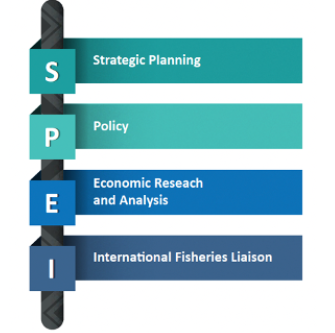
Strategic Planning provides clarity, sense of direction for NFA and outlines measurable goals.
It is a tool that is useful for guiding day-to-day decisions and also for evaluating progress and changing approaches when moving forward. It includes international development partner coordination, or development planning ensuring
donor programme and project design captures NFA and sector priorities as per the sector policy, sector strategic plans and NFA corporate plans; and corporate performance management is essential as it can boost engagement and productivity as engaged staff stay longer, actively involve themselves in the workplace and produce better results.
Policy Coordination enables alignment, synergy and prevents overlapping and conflicts of sector policies, which is increasingly important due to growing complexity of many policy issues.
The policy coordination involves facilitation and coordination of participation of relevant business units and stakeholders in the policy development and review processes, and undertake systematic monitoring of their implementation and impact in the sector.
Responsibilities also include undertaking public policy research and analyses on impacts on fisheries management and development as and when required to support NFA management in decisions making.
Economic Research and Analysis function is now imperative to provide high quality economic and financial analysis and advice on all aspects of the fisheries. This function will be responsible for the development, coordination and production of economic and financial analysis to inform NFA management decisions.
It will be responsible for the collection of data to support economic performance indicators for the fisheries sector and other socioeconomic research and analyses of various fisheries; assessing the economic viability and socioeconomic benefits to fisheries development/domestication proposals of all types; liaising and coordinating with the relevant units to provide socioeconomic analyses in support of their work.
International Fisheries Liaison involves the effective coordination of NFA and the Government’s engagement at the international level. Fisheries is a trans-national resource that respects no border With this characteristic, the resource is therefore managed at regional and international level through commitments and fora.
As a party or subscriber to a regional or international commitment, NFA needs to have a unit responsible for international fisheries affairs to take on these obligations in close collaboration with the central government departments and agencies on behalf of PNG government fisheries affairs to take on these obligations in close collaboration with the central government departments and agencies on behalf of PNG government
Finance and Accounts
Finance & Accounts is responsible for the management of the accounting and finance, risk management, payroll and asset management functions. This includes ensuring tight internal controls are in place to ensure only proper and approved use of all NFA funds and assets and that NFA meets all its statutory financial reporting obligations under the Fisheries Management Act 1998. Finance also provides managers with reliable, timely financial reports and information to facilitate good decision-making throughout the organization.
Core Functions
- Collecting, investing, disbursement and managing funds derived from NFA operations in accordance with NFA policy and legal requirements
Recording and reporting financial transaction to provide useful financial information for decision making and control and meet legal reporting requirement;
Coordinating and assisting with preparation of the annual plan and budget;
Ensuring compliance with financial statutory reporting requirements under the Fisheries Management Act;
Calculating and paying salaries, allowances and deductions in accordance with contracts and remuneration policies; and
Managing financial aspects of asset management in relation to the utilization and stewardship of land, buildings, office furniture, vehicles, infrastructure and other assets owned or leased by NFA
Priority Objectives
To undertake efficient & compliant collecting, investing, disbursing & managing funds derived from NFA operations in accordance with NFA policies and statutory requirements and recording and reporting financial transactions in order to provide useful financial information for decision making
To provide efficient services to our internal customers in calculating and paying salaries, allowances and deductions and ensuring effective management of NFA Fixed Assets.
Priority Actions
Timely provision of management and financial reports
Timely payment of creditors
Maintain internal control systems and procedures
Ensure effective Risk Management
Facilitate budget and annual plan process
Daily completion of license receipts for funds received from invoicing
Undertake expenditure reviews
Key Performance Indicators
NFA Board expresses positive endorsement for NFA financial management and audit reporting and NFA clients and Government demonstrate satisfaction with NFA financial transparency
Management approval of financial and audit reports
Timely dissemination of monthly reports on annual budget progress are provided to all NFA budget managers
Quick Links
NFA
Latest Articles
NATIONAL EXECUTIVE COUNCIL ENDORSES FISHERIES STRATEGIC PLAN
NEC ENDORSES FISHIERIES STRATEGIC PLAN 2021-2030Download
Read More- Directorate
- Corporate Services
-
Monitoring, Control
and Surveillance -
Licensing and Data
Management - Project Management
-
Audit Certification and
Catch Documentation - National Fisheries College
-
Fisheries Development
and Liaisons -
Aquaculture & Inland
Fish Farming - Fisheries Management
-
Strategic Planning, Economic
& International Fisheries - Finance and Accounts
Directorate
The Directorate is responsible for overall leadership of the organisation. The Directorate is directly responsible for managing communications with the Board and facilitating and managing the government’s obligations for major Public Investment Programs undertaken in the fisheries sector.
Core Functions
- Providing effective and transparent governance and ensuring that NFA is adequately resourced to perform its mandated functions and responsibilities
- Advising Government in all fisheries matters in full compliance with the Fisheries Management Act 1998
- Conducting the affairs of NFA in line with the Fisheries Management Act 1998
- Formulating strategic documentation for NFA Board consideration in relation to:
Strategic directions & opportunities including policy on risk management
Corporate Plan implementation
Annual Work Plan
Annual Budget
Strategic directions & opportunities including policy on risk management
Corporate Plan implementation
Annual Work Plan
Annual Budget
Performance Measures
Fisheries Management
Risk Management
Legal/regulatory compliance
Monitoring internal control system
Monitor stakeholders feedback
Priority Objectives
- To ensure transparent and accountable executive decisions are provided and implemented on all policy and operational matters
- To provide leadership and open communication in pursuit of sustaining a client focused knowledge- based organisation
Priority Actions
Ensure regular and productive NFA Board and Senior Management Committee (SMC) Meetings
Effective and timely implementation of Board Decisions
Comply with agreed external and internal reporting frameworks
Consolidate the Directorate Unit to ensure appropriate capacity levels for effective operation
Key Performance Indicators
Board and SMC meeting minutes confirm regular meetings and demonstrate productive decision making
Annual Work Plans developed, implemented and monitored
Leadership approval by key stakeholders
Corporate Services
The CS Business Group provides the needed institutional support services across NFA. The Business Group is under the leadership of an Executive Manager that provides overall corporate advisory services to the Managing Director through the Deputy Managing Director, Corporate Affairs.
The CS Business Group is made up of three (3) interconnected functions including Human Resource Management, Information Communication Technology, Assets (facilities) Portfolio and Land Management, and Administrative Support Services.
The Human Resource subdivision endeavours to develop and implement strategies and policies that focus on people and build NFA employees to be result-oriented, competent, productive, healthy, motivated and vibrant to effectively perform their roles and thereby contribute meaningfully to the objectives of the organisation. The HR Management Unit is responsible for ensuring best practice organisational reforms and developments, recruitment and selection, induction and employee awareness, training and development, compensation and benefits, payroll and leave administration employee social welfare, performance management and industrial relations in compliance with relevant NFA administrative policies and enabling legislations of PNG.
The Information and Communication Technology Unit is responsible for the NFA’s ICT infrastructure and systems needs including but not limited to hardware, software, business applications and liaison with service providers including effective implementation of service level agreements (SLA) to ensure consistency of service and reliable support and maintenance. ICT services are critical to the effectiveness of NFA in terms of communication in compliance with government regulatory framework and industry best practice. ICT also takes the lead in ensuring organisational automation and integration of available software for the effective and efficient operation of NFA business. ICT also ensures the effective reporting of all data housed in the NFA systems and external repositories.
The Property and Assets Management Unit provides effective property and assets management services to ensure cost-efficiency and return on investment of NFA property and assets commitments The sub-division manages the development, implementation and administration of policies and procedures to ensure effective planning, procurement, construction, inspection and property valuation management and disposal of property and assets in compliance with internal procurement policies in line with National Procurement Commission (NPC) procurement, disposal and contract management processes. In addition, it is also responsible to secure and maintain general insurance covers and medical covers through collective bargaining and provides oversight and coordination of institutional capital works program
OUR CORE ROLES AND RESPONSIBILITIES
The Corporate Services Business Group incorporates three functions whose overall aim is to effectively support NFA business functional areas in achieving the Vision, Mission, Key Results Areas and Goals of the Strategic and Corporate Plans of NFA.
The Human Resource Management Unit is responsible for creating a productive workplace culture and recruits, develops and manages NFA employees to be competent to perform their respective duties effectively in compliance with the NFA Administrative Policies and Procedures. Property and Assets Management Unit is responsible for the effective management and disposal of NFA property and assets and provides technical support, advice and services for the effective procurement, management and disposal of NFA properties and assets in line with NFA and NPC procurement policies and procedures. Information and Communication Technology Unit is responsible to provide reliable ICT support to enable NFA busir{ess units carry out their automation and integrate organisational ICT systems and procedures to achieve a paperless workflow of NFA business ensuring accuracy and efficiency in line with the NFA ICT strategy and policy.
Human Resources Management:
- Development of a Workforce Strategy that helps analyse current capabilities and future needs of employees that is strategically aligned to and supports the NFA current and future priorities outlined in the Corporate Plan.
- Effective and efficient Human Resource support services to all business units to enable them implement their functional responsibilities in line with NFA strategies, plans, policies and procedures.
- Nurturing and encouraging strong organisational culture based on core values and guiding principles across NFA thus breaking down silo mentalities.
- Ensure effective administration, implementation and enforcement of the NFA Administrative Policy and .Procedures and other HR policies to ensure staff comply with the provisions.
- Development and improvement of value added internal operational controls that promote best practice and systems in the workplace to ensure efficiency and effectiveness in HR operations.
- Development and implementation of a performance management system and ensure continuous systems improvement for accountability purposes.
- Job Evaluation to demarcate/right-size overlapping and duplicated functions across the NFA
- Ensure active engagement with Business Groups to review and align job descriptions to achieve the key result areas of the Corporate Plan.
- Development and implementation of induction programmes to ensure new employees are fully aware of NFA mandates, functions and responsibilities, and their obligations to perform to NFA expectations to achieve specific outcomes.
- Ensure active engagement with NFA Business Units and external stakeholders to coordinate employee learning and development, employee leadership and technical skills, employee career and succession planning development programmes to raise competency and productivity in the organisation.
- Development of information and communication strategy to ensure effective communication, reporting and provision of HR information to senior management and staff to keep them informed of HR related matters to ensure they are aware of HR best practices.
- Development of a workable employee performance appraisal system to enhance organisational productivity and advancement.
- Promotion of corporate image of the organisation.
PROPERTY AND ASSET MANAGEMENT
- Provide effective management and support to Property and Assets staff to ensure they carry out their duties in an efficient manner to produce expected outcomes in line with CSBG business plans.
- Effective management and enforcement of the NFA Internal Procurement and Assets Management strategy and policies.
- Development and improvement of internal operational controls that promote best practice in the workplace.
- Improvement of NFA property and assets, facilities and work environment to modern standards and within budget ensuring client satisfaction.
- Effective communication and reporting to management and staff on property and assets procurement, development, management and disposal in line with business and work plans.
- Liaise with contractors for the effective procurement, construction, administration, inspection and management of NFA owned properties and assets to ensure an operational standard.
- Ensure conducive work environment and organise for best practice staff occupational health and safety in all NFA office environments.
- In line with NPC and NFA Procurement policy and procedures, develop and implement procurement plans and budget and ensure every purchase is captured on the Hardhat Asset Management System for accountability and traceability.
- Provide accurate technical advice to EMCSBG and senior management, business units and relevant stakeholders including contractors for the effective management of NFA property and assets.
- Provide property and assets management reporting to assist management and the Board make informed decisions in line with budget provisions.
- Provide prudent risk mitigation, insurance management and maintain insurance coverage on Corporate general policies and staff benefit policies.
The Information and Communication Technology Unit
Information and Communication Technology:
- Efficient and effective management of Information Technology systems to support all NFA Business functions and services.
- Provision of technical advice and recommendations for the effective automation and integration of NFA systems to effectively implement core businesses ensuring sustainability and growth of the business increase revenue generation.
- Development and improvement of internal operational control mechanisms that promote ICT best practices in NFA.
- Development and implementation of ICT policies and strategies that focus the information technology needs of NFA and capability to respond to future challenges.
- Guidance on creating and implementing a seamless system that enable NFA conducts Its business operations
- Ensure effective communication for reporting on ICT developments and improvement to senior management and staff.
- Development of organisational ICT capacity to ensure staff are appropriately equipped
and resourced to effectively undertake their designated functions and the NFA website reflects the Dynamism of the NFA work programs.
- Coordination of technical support for the maintenance and upkeep of NFA computer and telecommunication systems.
- Ensuring efficiency in the administration of cyber security services for NFA computer systems and LANs.
Core Functions
Promote NFA wide adherence to the principles and practices of the NFA Office Manual
Manage and implement achievable and effective performance review processes and targeted professional development and training so as to sustain the principles of a knowledge based organization
Manage systems to undertake regular review and revision of the NFA organizational structure to ensure that NFA is appropriately structured to carry out its mandated functions
Provide timely access to legal advisory and support services for all of NFA
Manage efficient and effective Information Technology systems in support of all NFA functions and services
Ensure the effective implementation of policies and systems in support of staff recruitment, retention, remuneration and welfare
- Manage NFA properties and assets, maintain a dynamic asset register, ensure maintenance plans are in place and implemented in support of properties, offices, equipment, vehicles and staff housing
Ensure the effective operation and management of the NFA Library and stakeholder information services
Undertake the coordination of the NFA centralized file track file management system
Maintain a dynamic public relations and media office to keep customers and stakeholders informed
Work closely with the Provincial Support Section and the ISMR to coordinate training services and development for targeted commercial and community capacity building
Priority Objectives
Properties and information matters.
To provide an effective and efficient Corporate Services function that is responsive to all HR, Legal and Information Technology
To provide leadership in consolidating NFA as a well organized, client focused, solution oriented, transparent and knowledge based organization
Priority Actions
Coordinate an early review of the NFA organizational structure, job sizes, job descriptions, remuneration packages and performance management so as to ensure an appropriate structure is in place to achieve Corporate Plan targets
Develop and implement an NFA wide graduate internship program to contribute to succession planning and effective work program implementation
Review the policies and procedures of the NFA Office Manual and revise as required to clarify issues and give clear procedural guidelines to all personnel in order that operational policies and procedures are strictly adhered to and that respective functional areas are respected.
Establish the NFA library, associated information services and file track records management system as operational functions within the Corporate Services framework
Further develop integrated information management systems and an information management policy for the whole of NFA.
Coordinate the implementation of performance management and professional development practices and training policies so as to ensure achievable systems are in place and implemented.
Further develop organizational IT capacity to ensure staff are appropriately equipped and resourced to effectively undertake their designated functions and the NFA website reflects the dynamism of the NFA work program.
- Improve recruitment and staffing processes to ensure vacant and new staff positions are filled on a timely and transparent merit basis, succession planning is in place and recruitment is not constrained by external influences;
Develop and propose for adoption new policies on a staff housing scheme, NFA security management, risk management and mitigation, property management and maintenance planning and implementation, occupational safety and health management, HIV AIDS and staff life insurance
Undertake early coordination of a project to consider and propose options for future NFA head office relocation
Maintain effective work program planning and annual review so as to ensure effective service delivery and productivity across all Corporate Service functions
Review selected HR policies and processes with a view to improving HR system performance and efficiency
Establish an effective training coordination capacity within Corporate services and ensure close liaison with the ISMR, Provincial Support Unit, other NFA business units and stakeholders
Provide an immediate organization wide template for business unit annual work plan development and reporting that reflects the objectives and priority activities established under this corporate plan
Key Performance Indicators
- Corporate services reporting demonstrates progress and strong results in relation to priority actions across all corporate service functions and is positively endorsed by the NFA Boar
- Stakeholder consultation processes provide positive support to the NFA Directorate and the Board as to NFA service provision and client focus
Monitoring, Control and Surveillance
The main goal of the MCS Business Group is to adopt and sustain best practice systems in pursuit of increased compliance with national fisheries laws and policies, and relevant international fisheries obligations and standards.
MCS has three distinct, integrated activities that define its primary purpose in promoting and strengthening sustainable fisheries management & maintaining a healthy marine ecosystem.
Monitoring: This involves the collection of data on scientific, compliance, economical, and social aspects of the fisheries, and basic information on the fishers, vessels, and gear.
Control: This involves the regulatory conditions under which fishing activities are conducted.
Surveillance: The implementation aspect of fisheries management involves both government officials and members of the fisheries community and industry.
To achieve the core objectives of the MCS Business Group, three units were established as management tools within the Business Group namely, the Vessel Monitoring System
(VMS), Fisheries Observer Program, and Compliance and Enforcement. The units work through a range of systems to promote voluntary compliance by licence and unlicensed operators.
With the competing changes in fisheries management measures and business environment, the type of tools and systems used must be improved to be compatible and consistent with the regional and international MCS standards and requirements in effectively and efficiently delivering its operations and programs. This also means a transition to a more integrated MCS system in reporting, monitoring, surveillance, and enforcement going forward.
Vision
TO MAINTAIN AND STRENGTHEN A SUSTAINABLE FISHERIES MANAGEMENT AND A HEALTHY MARINE ECOSYSTEM FOR THE FUTURE.
Mission
TO ADOPT AND SUSTAIN BEST PRACTICE SYSTEMS THAT FOSTER FISHERIES COMPLIANCE THROUGH ENHANCED AND INTEGRATED MCS PROGRAMS.
The MCS unit comprises 3 core groups that each work simultaneously to achieve the objectives of the unit.
Core Functions
- Combat IUU fishing through national, joint regional and sub-regional surveillance and enforcement efforts.
- Combat breach of licensing conditions by domestic license operators and unregulated operators.
- Consolidate enforcement duties, linkages and agreements with appropriate enforcement and prosecution agencies and other relevant stakeholders.
- Coordinate and organize capacity building programs and activities in support of enforcement functions.
- Participate in new policy initiatives relating to enforcement functions.
- Cooperate with agencies to provide effective patrols of fisheries waters and the Torres Strait Protected Zone;
- Coordinate and implement a focused program of fisheries compliance awareness.
Priority Objectives
- Building enforcement capacity through the recruitment and training of additional enforcement officers.
- Undertake effective consultation, interaction and relationship development with other business groups and enforcement agencies so as to build national enforcement capacity.
- Plan and implement a risk identification and mitigation strategy so as to address threats to enforcement performance and MCS operations.
- Plan and implement multi-agency surveillance, monitoring and enforcement activities
- Undertake targeted training to build capacity for successful investigation and prosecution of access and license infringements and IUU activities
1. Observer Program
The Fisheries Observer Programme plays an important role as one of the key monitoring tools in the management of tuna and other commercial fishery activities. They are essentially the “EYES and EARS” of NFA, and other regional bodies. The raw data collected is needed for verification of activities and informs important fisheries management decision-making.
There is a legal requirement to have 100 percent observer coverage on all licensed tuna purse seine vessels fishing in the WCPO within the area bounded by 20°N and 20°S, and a minimum of 5% observer coverage for long line and other fisheries covered by the WCPFC. The PNG Fisheries Observer Programme is sanctioned by the Fisheries Management Act 1998 as amended and the standards and framework of the Pacific Islands Regional Observer (PIRFO) Programme.
The Fisheries Observer Program is guided by the SPC and FFA certification standards and training policy manual which provides a basis for all observer training. On these platforms, observers are provided training including, seamanship, compliance, and scientific aspects.
Consistent with the WCPFC’s Conservation Management Measures (CMMs), the observer program ensures amongst all other things, the availability of useful catch and effort information from all major commercial fisheries to assist in management and decision making.
The existence of the Fisheries Observer Programme ensures a best practice. Fisheries Observer personnel are managed as an essential MCS tool.
With the restructuring of NFA during the years 2000 and 2001 and the consequent reduction of fisheries enforcement and scientific staff, the role of observers in fisheries conservation and management is more important than ever.
With the current operational needs of the program, the future emphasis of the program focuses on transitioning to an electronic based system including e-reporting and e-monitoring and improving the efficiency of its operations through outsourcing management systems
Core Functions
Manage a best practice PNG fisheries observer program to increase the capacity for observer coverage, collect relevant data and monitor compliance with license conditions for fishing vessels operating in PNG waters
Facilitate observer placement in the national, sub-regional and international observer programs as arranged through FFA
Ensure effective observer debriefing and observer data management in support of the wider operational needs of the MCS NFA
Maintain an active observer training program so as to build observer capacity in ensuring effective reporting and production of quality and reliable observer data
Priority Objectives
To ensure a best practice and proactive enforcement capacity that will prevent, deter and combat IUU activities through effective surveillance, enforcement and prosecution practices, development and implementation of relevant enabling policies and cooperation and strategic alliance with national and regional agencies.
To effectively operate a compatible and secure Vessel Monitoring System that is capable of monitoring and providing intelligence on vessel movement and activity for surveillance and enforcement purposes, and is responsive to regional and sub-regional requirements.
To effectively operate an internationally recognized and approved regulatory food safety management system that conveys and implements required standards and facilitates regulatory compliance so as to ensure the success of PNG seafood products in national and international markets
To develop and maintain a highly competent and recognized national observer program that demonstrates high performance in collecting quality resource data and monitoring compliance with fishery license conditions and is responsive to regional and sub-regional requirements.
- Increase the number of available observers through a committed training program and the early adoption of the proposed regional standard Pacific Island Qualified Fisheries Observer training and certification program.
Manage a best practice PNG fisheries observer program to increase the capacity for observer coverage, collect relevant data and monitor compliance with license conditions for vessels operating in PNG waters
Facilitate observer placement in national, sub-regional and regional observer programs
Ensure effective observer debriefing and observer data management in support of the wider operational needs of the NFA
Maintain an active observer training program so as to build the numbers of trained observers and ensure the quality and reliability of observer data and reporting
Recruitment of five or more observer port coordinators
Key Performance Indicators
- At least ten successful coordinated inter-agency patrols are conducted and reported annually to the NFA Board with positive endorsement and 80% of cases progressed to court or Summary Administrative Panel (SAP) are effectively prosecuted
- NFA VMS information is successfully integrated into the MCS function and effectively utilized with positive activity reporting submitted to NFA and other relevant agencies
- PNG achieves and sustains national and internationally recognized food safety certification standards and PNG producers of fish and fishery products are internationally recognized for high quality products
- PNG is able to improve levels of observer coverage in key target fisheries and the quality of observer data is validated through feedback from data users
- ACU becomes a separate Business Group
3. Vessel Monitoring System
(VMS)
The VMS or sometimes referred to as Asset Tracking System (ATS) is only one of the many tools used in MCS although the valuable information on an asset’s position and the record of its movements makes ATS very useful as well in enhancing the operation of the other conventional tools of MCS such as marine patrols or aerial surveillance.
The near-real time reporting capabilities of ATS are being seen as very important for the collection of catch reports and scientific data.
Although this is presently considered a secondary objective in most ATS establishments, the use of such reporting will also have a significant impact on the early warning systems of fisheries management, resulting in more timely “best scientific evidence”.
The ATS encompasses a comprehensive Vessel and Client Register which allows near real-time tracking of vessels utilising VMS and Automated Identification System (AIS), fisheries observers, small craft, and tracking of Fishing Aggregate Devices (FAD). The ATS is a core application centred at the heart of the NFA fisheries information management platform.
The platform consists of a suite of integrated modules that allows NFA to use the system for fisheries licensing control and issue, Catch Documentation and accountability of catch tracing, and Compliance, and Case Management for
accountability and transparency with all compliance-related issues and actions. In addition, a comprehensive Observer module allows for Observer booking & management, complete electronic reporting, and debriefing, and provides
a 24/7 safety linkage with Observer Programs for onboard Observers.
A compelling component of the system is the Vessel Day Scheme (VDS) module where ATS plays an important role to collate positional data which assists agencies to view all VDS interactions and provides full accountability and transparency with the scheme allowing fisheries agencies and the fishing industry to be confident the day scheme data displayed in the Fisheries Information Management System (FIMS) is accurate and not compromised.
The small-scale fishers are a key part of the global blue economy and there are increasing calls to monitor their activity. The VMS envisages through its capabilities to approach this by addressing data gaps in the coastal fisheries to gain better knowledge about what, where, when, and how much fish are caught to provide accurate information for decision making to connect, protect and empower artisanal fishers.
Core Functions
- Coordinate a VMS intelligence surveillance program for national and regional integrated program.
- Coordinate 24/7 monitoring of fishing in restricted fisheries waters and facilitate effective warning and reporting to appropriate agencies.
- Ensure an effective VMS audit capacity and build the internal VMS management capacity through targeted training, skill development and technical assistance
- Actively participate in regional and sub-regional consolidated VMS meetings and activities
Priority Objectives
- Build VMS monitoring capacity through the recruitment and training of additional personnel so as to allow 24/7 coverage
- Undertake effective operation and management of the VMS system and the Vessel Day Scheme
- Enhance systems for effective internal, inter-agency, national, regional and international liaison and reporting of VMS derived information and intelligence
- Work towards establishing VMS as a separate unit under MCS
3. Compliance and Enforcement Unit
The Compliance & Enforcement Unit is responsible for surveillance and enforcement programs of NFA through the existing national legislative framework by ensuring licensed operators are compliant with requirements when engaging in fishing and related activities. The unit is also responsible for the management of inshore patrol craft (IPC) operations mostly for coastal area surveillance coverage.
The C&E comprises of four subunits with specific roles and responsibilities that contribute to the overall achievement of the unit objectives. These sub-units include Enforcement and Prosecution, Compliance, Asset and Exhibits, and Surveillance. The responsibilities performed are determined by the national legislative framework.
The C&E unit is compelled to ensure sound enforcement practices and proactive responses to non-compliance measures and enhancing human resource capacity and
asset capability that will assist to prevent, deter & combat IUU fishing activities through effective surveillance, enforcement and prosecution practices, engaging in development and implementation of relevant enabling policies and legal instruments, strategic and cooperative alliance with national and regional agencies including promoting voluntary compliance and sustaining surveillance assets.
The key priority areas of which compliance and enforcement are centred into capacity development, surveillance, inspections, investigations, prosecution, and education and awareness programs.
One of the key upcoming KRAs of the unit is the development and enhancement of the Compliance Module in the FIMS. This will be a consolidated effort focused on enhancing a robust fisheries case file system to be ably shared with other relevant agencies where required including exchange of compliance related information.
In addition to existing efforts on eradicating IUUF activities, the C&E unit will enhance the timely and effective responses to all potential non-compliance identified by national or regional agencies as well as other coastal states. More emphasis also will be towards a holistic coordination and collaboration between NFA and Inter-Agency Partners on MCS obligations.
Noting the current developments in the use of new and emerging technologies to assist MCS operations, the unit stands prepared to adopt technologies that are relevant for its purpose and user friendly for effective and efficient surveillance, compliance, and enforcement activities.
4. Audit and Certification Unit
The Audit and Certification Unit is one of the units within Monitoring, Control and Surveillance Business Group. The ACU unit is responsible for ensuring that seafood processors understand and comply with export quality standards. It is important to ensure that PNG seafood export products comply with the food safety laws and regulations of importing countries, and thereby maintains its access to international markets, particularly Europe.
Core Functions
Manage the official fish and fishery products control systems and processes to ensure PNG meets domestic and international market access requirements
Control and regulate fish and fishery products safety and quality programs in accordance with the national and international legislative requirements and best practices;
Undertake stakeholder and agency liaison, consultation and cooperation in support of relevant policy development and national and international regulatory compliance
Priority Objectives
- Coordinate and facilitate targeted interventions to build technical capacity in seafood safety and regulatory compliance
- Build ACU capacity in product testing and certification through improving laboratory operations and recruitment of qualified personnel.
- Establish effective work programs for newly approved ACU staff positions and ensure timely recruitment to these positions
- Maintain strategies to ensure ACU performance and capacity in relation to regulatory requirements for audit, certification and reporting
- Work towards establishing ACU as a separate Business Group
- Ensure effective stakeholder and agency liaison, consultation and cooperation in support of capacity development for national and international regulatory compliance
- Liaise with NFC and other relevant training providers to further develop and implement targeted training and education programs in support of seafood safety and regulatory compliance
- Coordinate processes to resolve issues and challenges in ensuring PNG meets national and international market access requirements for fish and fishery products
Licensing and Data Management
The Licensing and Data Management Group is responsible for processing license applications and renewals, receiving and entering catch and export data into relevant databases, providing information to stakeholders and regional organizations.
Core Functions
- Effective, timely and compliant administration of the NFA licensing processes
- Monitoring and ensuring the integrity, accuracy and completeness of data received under licensing requirements and ensuring data entry, security, analysis and dissemination processes are in place
Priority Objectives
To streamline the licensing process to ensure integrity and timely due process to meet the needs of both NFA and license holders
To liaise with Corporate Services to realign the function of library and file management within NFA
Priority Actions
- Ensure timely processing of license applications and timely issuance of approved licenses and implement the recommendations of the licensing review as directed by the NFA Board
- Ensure strict, accurate and timely reporting of catch and export data to NFA by licensed operators and maintain close cooperation with MCS in implementing non-compliance response actions
- Maintain a central fisheries database and publish reports and summaries for internal and external clients.
Key Performance Indicators
Establishment of a timely license process as exemplified by the level of clients satisfaction as reported to the Directorate and the Board
Successful operation of a secure and user friendly database that provides effective storage and retrieval of information and tools for analysis as exemplified in the provision of datasets and information to agreed users as reported to the Directorate and the Board
Core Functions
- Ensuring effective project identification, design, implementation, monitoring, evaluation, and sustainability beyond project completion
- Undertaking economic and benefit analysis in relation to major fisheries projects
- Facilitating the successful negotiation of fisheries trade agreements
- Maintaining effective working relationships, networks and strategic partnerships in pursuit of successful project identification, implementation and sustainability
Priority Objectives
- To successfully complete and subsequently monitor impact projects aimed at empowering and improving the quality of life for the people of Papua New Guinea
- To undertake cost benefit analysis and socio-economic surveys of major impact projects and trade negotiations so as to validate viability and benefit
- To undertake key leadership in relevant trade negotiations so as to ensure positive outcomes for Papua New Guinea
Priority Actions
- Undertake consultation with key stakeholders to identify and define project opportunities
- Design effective project proposals
- Strengthen and train professional staff who are multi-skilled in relation to effective project development, management and trade negotiations
- Improve coordination of key line agencies to ensure effective project implementation
- Identify and secure funding opportunities for project support
- Continuous development of the NFA project portfolio and sustained monitoring and evaluation capacity
- Assess and adopt best practice models for local-level participation and ownership in project activity
- Effective international trade negotiations and associated economic benefit analysis
Key Performance Indicators
NFA managed projects are completed on scheduled and within budget and project monitoring and evaluation plans are in place and implemented
Production of timely reports on project economic evaluation, cost benefit analysis and socio-economic surveys
Successful trade negotiation exemplified through signed and binding agreements
Audit and Certification Unit
The ACCD Business Group is responsible for maintaining the Competent Authority (CA) status of the NFA in the international, regional and national arena. Thus, on behalf of the NFA, the ACCD Business Group is subjected to a third-Party Audit from the importing countries. We ensure a robust regulatory framework for official controls for health and catch certification systems, and standards are in place and compatible with the international best practices.
With the Government’s export-led model of development and the favourable treatment policies and the access fees discounts in the fisheries sector, that prioritised fishing vessels linked to onshore plants, the roles to be played by audit, certification, and catch documentation functions in expanding and enhancing of international trade and market access for fisheries products.
WHAT WE DO
Core Functions
- Regulate and monitor food and feed safety to protect consumers;
- Ensure aquatic animals and plants are free of contaminants through surveillance and testing to meet national and international market access requirements;
- Ensure provision of adequate and accredited laboratory testing services for fish and fishery products;
- Monitor, and verify the legality of fish and fishery products through traceability;
- Ensure export requirements of fish and fishery products are maintained in accordance with national and international standards;
- Ensure facilitation of assistance to fish business operators to provide awareness and information in relation to the application of standards.
Core Responsibilities
- Administration of Operational Policies and Procedures
- Audit/Inspections of Shore-based Facilities & Fishing Vessels (PS, LL, RC, etc.)
- Sampling & Testing for Food and Water
- Stakeholder Collaboration (MoUs/MOAs/Technical workshops and seminars))
- Thermal Process Audit & Verification
- Export Approval and Certification
- Risk Management Program (Environmental Monitoring Program (EMP) & Virus Testng
- Monitoring and control of Market Access conditions
- Import monitoring and control
- Administration of Laboratory Functions
- Key Projects – e-Projects (Online systems – vessel reporting)
- Research & Validation
- Staff Training & Competency
CDCU Core Responsibilities
- Administration of Operational Policies and Procedures
- Catch Monitoring and Documentation
- Catch Verification and Certification
- Management of monitoring and certification records
- Staff Training & Competency
- Management of Port Offices
- Port State Measures Implementation
ACCD Timeline
National Fisheries College
The Institute of Sustainable Marine Resources is to be established as a new Division of the Authority in 2008. The Institute encompasses the National Fisheries College and its associated training courses and programmes and the management of the Nago Island Research Facility. The Institute will continue to provide core training in fisheries and seafood and, in addition, will expand training activities to include aquaculture and community fisheries. NFA has established the Institute as a means to better resource NFA policy implementation in relation to human resource and capacity building in fisheries and marine resource management and development.
Although part of NFA, the Institute will operate semiautonomously because of its location in Kavieng and in reflection of the specialized nature of its operations.
Core Functions
Provision of effective and well organized training and education programmes in support of human
resource skill and capacity development for the effective sustainable management and development of Papua New Guinea fisheries and marine resources
Efficient development and management of resources, facilities and equipment and provision
of administrative and organizational services in support of program and activity development
and delivery
Give effect to NFA policy implementation through strategic project and activity implementation,
income generation and strong stakeholder relationships
Priority Objectives
To establish the ISMR as the primary national provider of technical and applied training in fisheries, post harvest, culture, marine resource management and sustainable development and ensure effective organizational and fiscal management
To offer a range of cost effective, well received and accredited courses and programmes which are reflective of the training and development needs of the fisheries and marine resources sector, professionally delivered by highly motivated staff and fully utilise and maintain ISMR and NFA assets and resources
To ensure interactive working relationships with all stakeholders and establish Provincial level networks for offsite course and programme delivery and give effect and strategic implementation support to NFA policies in fisheries management and development
Priority Actions
Formalize ISMR organizational structure and arrangements and establish financial and administrative procedures in accordance with existing NFA protocols
Plan and implement full staff recruitment
Develop and implement strategies to inform stakeholders and promote ISMR functions and Services
Liaise with Fisheries Management Group and other stakeholders in a coordinated approach to the construction and operational development of the Nago Island Research Facility and the development of the tourism partnership
Establish systems and procedures for the cost effective management, maintenance and operation of NFA assets and resources in New Ireland
Develop and implement strategies to attract donor projects, co-funding, partnerships, cost
recovery and income generation in support of ISMR operations and activities
Prepare an annual plan for the delivery of existing ISMR courses and undertake to ensure course
and programme delivery according to the agreed schedule with target annual short course enrolments of 500 students
Ensure course participant evaluations are completed for all courses and that evaluation information and feedback is available for effective programme review
Effectively develop and manage the Kavieng based delivery of the Diploma/Degree in Marine and Fisheries Resource Management
Ensure compliance with academic course and programme quality control and moderation procedures
Maintain a commitment to the professional development and employment satisfaction of all staff in order to promote a positive and dynamic learning environment
- Sustain a capacity to respond to stakeholder demand for the development and delivery of new courses and programmes
Promote course cost recovery mechanisms in programme delivery and ISMR operations
Maintain systems for best practice organizational management with open communication and dynamic leadership
Ensure open and direct communication with stakeholders in relation to course and programme delivery and management, and strive to earn and retain the respect of key partners
Give priority to the early development of a new purse seine crew training course to train crews for employment on Chinese and Taiwanese purse seine vessels
Develop and widely distribute dynamic ISMR promotional pamphlets and information publications
Prepare media bulletins documenting the functions and roles of ISMR
Plan a strategy for Directorate visits to key Provinces to engage stakeholders and seek out partners for Provincial level programme delivery of selected courses
Further develop Train the Trainer modules so as to develop a national network of qualified and confident trainers in small fishing operations, basic post harvest, small business management and community based fisheries and marine resource management
Liaise with Fisheries Management Group to develop and establish training programmes and activities to utilize the facilities and resources of the Nago Island Research Facility (NIRF)
Undertake a proactive role in facilitating marine resource management and development information and education resources preparation and distribution
Provide facilitation to community based fisheries management processes and strategies for alternative income generation for coastal communities
Key Performance Indicators
- To establish the ISMR as the primary national provider of technical and applied training in fisheries, post harvest, culture, marine resource management and sustainable development and ensure effective organizational and fiscal management
- NFA Board approves organizational structure and National Training Council (NTC) and Fisheries Technical Advisory Committee (FTAC) endorse ISMR quality assurance and operational policies and procedures and commend these to the NFA Board which in turn acknowledges the positive performance of the ISMR in relation to its establishment goals
- ISMR annual course programmes are delivered as scheduled with at least 500 short course enrolments and 90% student and client satisfaction.
- Staff professional development plans are achieved and ISMR annual maintenance plans are prepared and 100% implemented
- ISMR annual reports are well received and positively endorsed by the NFA Board, particularly in relation to progress with priority action implementation
- At least three partnerships are in place for Provincial level program delivery and TOT programmes are established for small business, small fishing operations, basic post harvest and community based fisheries and marine resource management
- CFMDP marine resource management comics, posters and information are annually reprinted and distributed and there is a positive increase in the number of CBM plans in place for area fisheries management
Fisheries Development and Liaisons
The Fisheries Development and Liaisons Division is responsible for developing and facilitating strong links and regular consultation between NFA and both the commercial fishing industry and provincial and community fishery stakeholders. In particular the group has primary responsibility for promoting and facilitating the development of commercial and community fisheries by providing information, contacts and advice in areas such as business management, markets and fisheries resources, and access to donor or other development funding. It leads access negotiations with foreign deepwater fishing nations and coordinates participation and policy issues for bilateral and multilateral fisheries arrangements.
Core Functions
- To provide leadership in consolidating Acting on behalf of the Government in relation to any domestic or international agreement relating to fisheries, including access agreements and fisheries management agreements
- Liaising as appropriate with provincial & local level Governments, district authorities, communities and relevant stakeholders in order to facilitate fisheries development and management strategies
- Liaising as appropriate with agencies and persons, including stake holders, industry, government agencies, regional, international organisations and experts in order to facilitate maximised sustainable and equitable benefit from PNG marine and fisheries resources
- Introducing and appraising stakeholders on fisheries sector development policy issues, trade and market development opportunities and programs of the Division and overall activities of NFA
Priority Objectives
Provincial Support
To develop and provide a highly responsive, transparent and effective operational processes and procedures with provincial and local level governments to facilitate effective partnership and working relationship in developing and managing coastal marine and fisheries resources.Industry Development
To establish a competent, responsive and transparent process with regional and international fisheries management and development organizations, fishing partners and key government agencies to facilitate processes for effective and sustainable fishery development plans and investment initiatives in order to ensure maximum socioeconomic benefit to PNGTrade Development and Marketing
To establish a highly responsive transparent communication process with relevant business groups within NFA, the domestic fishing industry, provincial administrations and all relevant stakeholders to facilitate trade development and market access for PNG seafood products and provide strategic assistance to exporters in trade promotion activities
Priority Actions
Provincial Support
- Undertake regular reviews and consultations in relation to the MOAs between the NFA and Provincial Governments and communities to effectively appraise and promote current NFA-Province capacities, institutional arrangements and environments to promote vibrant fisheries development and management in the provinces
- Initiate close consultation with NDB to establish a lending procedure of the fisheries credit facility that can be easily be accessible by the fisher folks and fish farmers
- Facilitate and coordinate in close consultation with DCI and provinces, on the establishment of fisheries cooperatives or associations to enable access to credit, grants, PDF and other donor assistance.
- Liaise with other NFA business units, provincial administrations and stakeholders to encourage the preparation and adoption of provincial level fisheries development and management plans and community based fisheries management strategies
Industry Development
- Facilitate and coordinate regular consultation with the fishing industry on national and regional fisheries policy in industry development and resource management and in relation to interventions and investments affecting the fisheries sector in PNG
- Provide effective representation for PNG at relevant national, regional and international meetings in regard to fisheries management, trade and development
- Initiate consultation with the relevant National Government agencies and seek technical input from regional fisheries organizations to further document fisheries management an development plans which can further advance economic benefits to PNG
- Work in close collaboration with the NFA Projects Unit to facilitate and coordinate projects derived from bilateral access arrangements, DEVFISH, INFOFISH and others
- Provide services for the effective management and monitoring of project and funding applications to the NFA Reserve Fund Committee and Project Development Fund
- Liaise closely with the ISMR and the NFA training coordinator to plan and organise effective training in support of skill development initiatives for NFA staff and across the sector
Trade Development and Marketing
- Facilitate and coordinate the participation of PNG fishing industry in the national and international seafood exhibitions
- Initiate and undertake market research and surveys
- Prepare and disseminate market information to the PNG fishing industry, seafood exporters and interested stakeholders in close consultation with INFOFISH and other regional fisheries organizations through FISHTRADE news, NFA website and other means of communication
- Build capacity to Improve officers’ competencies and organizational skills and capabilities in order to provide high level and competent technical advice to stakeholders on development initiatives
- Participate in processes to further develop a sustainable fisheries based successful regional marketing strategy
Key Performance Indicators
Provincial Support
Reports and consultations, as tabled to the Directorate and Board demonstrate positive progress in all aspects of priority action targets and MOA review and implementation as documented in work plans and obtain the positive endorsement of the Board
Industry Development
Reports and consultations, as tabled to the Directorate and Board demonstrate positive progress in all aspects of priority action targets and this is reflected in continuous positive investment and return to PNG from domestic based fisheries and processing as documented and demonstrated in economic analysis reported to the NFA Board
Trade Development and Marketing
Reports and consultations, as tabled to the Directorate and Board demonstrate positive progress in all aspects of priority action targets and this is reflected in improved prices for marine resources at local and national levels, increased export volumes from established sustainable fisheries and the offering of new PNG value added products to the marketplace
Aquaculture and Inland Fish Farming
The Aquaculture Unit is part of the Fisheries Management Unit of NFA.
The overarching scope and mission of the unit ensures that PNG fisheries are managed to obtain maximum sustainable benefit, taking into account a balanced view of fishery science, environmental impact, social factors and economic development.
OVERVIEW
Our Primary Functions
Give Technical Assistance – the Aquaculture unit provides technical assistance to interested/existing farmers in terms of information and advice. If required we send staff to relevant sites for a more closer engaging collaborative support network.
Provide Workshops and Training – The unit can also run workshops and extensive pragmatic and hands-on training for interested farmers on fish farming and other aspects of aquaculture practices.
Conduct Surveys – The unit also encourages and supports surveying of existing inland aquaculture projects to update and see the current status of its overarching development in PNG.
Set Trial Projects – Because of the early stages of aquaculture development in PNG, NFA also seeks to the work with committed people to run trial pilot aquaculture projects to assess the ongoing feasibility and to plan and prepare to engage in expansion as required.
Aid Fingerling Distribution – The Unit can also assist in finding seeds of especially GIFT Tilapia and common carp, and aid in the corresponding distribution to farm sites.
Aid In Marketing – The unit, in collaboration with other units within NFA, can help in finding suitable local and international markets for the output of the aquaculture initiatives.
Work with Collaborative Partners – To help oversee the overarching development of aquaculture in PNG, the unit works with a range of relevant entities including: Government bodies and businesses, NGOs, Education institutions and other relevant stakeholders.
Objectives
- To establish Papua New Guinean aquaculture as a solid and viable business industry.
- To raise PNG aquaculture products to achieve maximum returns in both national and international markets, as a sustainable and premium product.
- Food security and poverty alleviation in PNG at a subsistent level.
- Facilitate education to Papua New Guineans about aquaculture as an alternative means of producing fish and other aquatic products for economic profit and food supply.
- Integration of aquaculture with agriculture by existing artisanal/subsistent farmers.
Development Strategies
Aquatic Health Management
Aquaculture Feed Development
Aquaculture Training
Food Security and Poverty Alleviation
Environmental Sustainable Aquaculture Practices
Investment in Aquaculture Research
Effective Communication and Dissemination of Information
Market Development and Trade Promotions
The National Aquaculture Policy
NFA has also set out a National Aquaculture Policy which sets out policies, strategies and guidelines for the development of aquaculture in an economically, socially and environmentally sustainable manner in PNG.
National Aquaculture Development Management and Advisory Committee (NADMAC)
NADMAC is a sub-committee set up by NFA with members from different aquaculture stakeholder departments and organisations including: research institutions, educational institutions, NGOs, Government Departments including provincial government representatives, commercial industries and the subsistent sector.
The purpose of this committee is to discuss and oversee development and manage ongoing overarching issues of aquaculture in PNG.
Our Development Priorities
NFA realizes and acknowledges three major constraints to aquaculture development in PNG. NFA is working closely with a range of relevant partners to drive initiates and solutions to ensure an ongoing and sustainable expansion of the aquaculture sector in Papua New Guinea.
Aquaculture Feed Development
Studies and trial have been done on feed formulation using locally available ingredients and training and feed production have been given to farmers.
Mini feed processing mills have been bough and set up at selected places in PNG.
Fingerling Production
Distribution centers (HAQDEC & DAL) and farmers are constantly producing fingerlings for distribution to farmers
With the introduction of GIFT tilapia, production of fingerlings should be easier at a subsistent level
Aquaculture Knowledge
Proper Aquaculture knowledge is lacking in most parts but with continual support from ACIAR and DAL, workshop training have been conducted successfully in different part of the country.
Example of Papua New Guinea Aquaculture Projects
- Sirinumu Cage Culture Project – A trial project by the Aquaculture Section of NFA to see the feasibility of doing cage culture of GIFT tilapia and possibly barramundi in the Sirinumu Reservoir
Coconut Products Limited Prawn Farm – A Prawn Farm in Rabaul, East New Britain Province, which is currently breeding post larvae and producing prawns.
Coral Sea Mariculture Pearl Farm – A well established gold lip pearl farm currently producing pearls for export
Western Province Sustainable Aquaculture – A barramundi for restocking and also supply interested barramundi famers with seeds
Others – There are also a large number of inland semi intensive fish farmers mainly in the highlands of png farming carp and GIFT tilapia in ponds.
Fisheries Management
The Fisheries Management Business Group (FMBG) is a division within the PNG National Fisheries Authority. Its primary business is centred on the sustainable management of fisheries and marine resources based on scientific research and innovation. Its functions reflect also the core of NFA’s mandate as provided in the Fisheries Management Act 1998.
Over two decades, in the existence of NFA, the Fisheries Management Business Group continues to be the central entity focusing on international, regional and domestic partnerships and collaborations in developing individual fisheries in PNG. Significantly, sustainable resource management based on reputable scientific information and equitable economic benefits supporting local livelihood takes centre stage for all its overall purpose There are currently six active trading fisheries managed under the FMBG.
Tuna fishery is the main income earner of NFA contributing to the country’s economy significantly. Others include Sea Cucumber, Prawn fishery, Lobster fishery, Mud Crab fishery and Aquarium fishery. These fisheries are typically managed based on developed and gazette Fisheries Management Plans that guide, among others, the key operations of licensing and data management, trade, monitoring, control and surveillance.
There are additionally some previous and newly encouraged fisheries under FMBG structure that still need more information or are under research for the development of their trade. These include Shark fin fishery, Trochus fishery, Fish maw fishery, and Mid-water trawl fishery.
FMBG also prioritises the PNG government’s focus on coastal community development. The significance of this endeavour favours the development of SME and sustainable livelihood addressing domestic and international objectives of partnership and human development such as Food Security.
The two community livelihood projects under FMBG that reflect this agenda include the IFAD and Trap Net Project.
Further, the Creel and Market Survey and Mangrove and Coral Rehabilitation Research Projects under FMBG supports continuous collaboration and experience for resilience of coastal communities towards life threatening challenges such as Climate Change, he NFA also recognizes the importance of healthy fisheries habitats for commercial and recreational fisheries, hence protecting and restoring essential fish habitats help to maintain productive fisheries and rebuild depleted stocks in PNG. They form the basis of information to guide decision making for the future of coastal fisheries development in PNG.
Core Functions
1. Fisheries Management Systems
- Periodically reviewing existing and developing new fishery management plans
- Monitoring and implementing updated and effective fishery management measures
- Ensure that there is an institutional and operational framework, appropriate to the size and scale of the fishery, that is capable of delivering sustainable fisheries
2. Information dissemination
- Arranging the design, collection, processing, reporting, and publishing of relevant information on fisheries and marine resources
- Work closely with key stakeholders to ensure resource owners, developers and provincial governments understand the requirements of relevant fisheries implementation programs and management plans.
- Publishing reports, awareness and general information dissemination to relevant stakeholders
3. Stakeholder Collaboration
- Liaising with international and national agencies including development partners to access research and development expertise, technical equipment, advice and information
- Regional technical coordination
- Community engagement and participation
4. Scientific Research and Development
- Approving and facilitating research required for the effective development and management of fisheries and marine resources
- Preparation and development of new and emerging fisheries
- Stock Assessment
KEY PROJECTS UNDERWAY BY FMBG
INSHORE FISH AGGREGATING DEVICE (IFAD) PROJECT
The Inshore Fish Aggregating Device (IFAD} Program was conceptualised and initiated in 2010 with the intent to improve fisheries production and income for coastal and island communities whose livelihoods are heavily dependent on the fisheries resources.
IFAD as implemented by NFA is a direct benefit to island and coastal communities in PNG. Fishermen and women are having access to more fish caught around IFAD’s whilst relieving pressure on coral reefs to revive. Income is generated through fish sales in accessible local markets.
A total of 15 IFAD’s is allocated for each province mainly in island and coastal communities. Construction and deployment have so far been completed in Manus, Morobe, Madang, ARoB, and recently in East Sepik Province.
NFA will continue to do construction for the remaining Maritime Provinces from 2023 to 2025. The table below outlines the goals, objectives, and key indicators of the IFAD program.
| Goals | Objectives | Key Indicators |
|---|---|---|
|
Food Security |
Enable access to more consumption of IFAD fish protein in house’s per capita |
|
|
Increasing income generation |
Increase income for fishers and fish vendors through enhanced production in fishing, processing and marketing. |
|
|
Improve reef resilience
|
Shifting fishing pressure on coral reef fish to IFAD to increase reef biodiversity. |
|
General activities for IFAD in a province are as follows:
- Consultation and Inception
- Awareness and Baseline Assessment
- Construction and deployment
- Training and capacity building on Post Harvest Operations, Small Fishing Operations, Data Collection
- Monitoring and evaluation
RESOURCE ASSESSMENT
The creel and market data survey are vital for coastal fisheries information. It is an ideal assessment and monitoring tools to use and fill in the information gap that we lack. It is inexpensive, requires little specialist equipment, can provide information on the state of resources, and focus on the heart of food security and livelihoods for coastal and island populations. Most of the small, scattered fisheries are the backbone of much of community life but they do not generate significant income for national GDP. Further, the amount of income generated from various subsistence and artisanal fishing is somewhat anecdotal.
In 2014 concerns were raised on the state of coastal fisheries activities, both subsistence and artisanal. In line with that, and the aim of developing the coastal fisheries sector in PNG, NFA implemented the data collection program through creel and market surveys in 9 Maritime Provinces. The program aims to address information gaps relating to catch, production, and socio-economic information on each fishery activity within the coastal waters of PNG. The effectiveness of the program, however has come into question when there was no unavailable information (data) on the state of coastal fisheries activities, and this was due to the following issues;
- data defragmentation,
- limited resources and capacity at provincial level agencies,
- available data is minimal and of inconsistency quality
- not recognize as major contributor to GDP,
- data repository and policy framework
It is thus important to identify the current issues in coastal fisheries as its critical part of the process in data collection. Effective monitoring with a robust data system will determine the importance and contribution of coastal fisheries for long term data collection.
The objective of this project is to determine and quantify creel,and market data to understand the importance of;
- Coastal fisheries contribution towards healthy nutrition, livelihoods, and food security,
- impact of climate change to coastal fisheries and its ecosystem,
- Value of coastal fisheries and its contribution to GPO and,
- Quantify coastal fisheries production (yield) and specific indicators for coastal fisheries production for annual reporting.
- Data and its fundamental importance to coastal fisheries management are crucial. With an effective implementation approach through proper tools and processes will improve the situation.
New Approach in data collection process and procedures
SPC’s Coastal Fisheries and Aquaculture Program (“CFAP”) under the FAME Division has developed a suite of tools for Pacific Island Countries and Territories, to facilitate a transition from paper to electronic-based monitoring of their coastal fisheries called the e-data system or “EDS.” NFA has requested SPC’s CFAP to provide on-site training to NFA staff in the use and integration of the EDS into their coastal fisheries sampling protocols for conducting market and creel survey. Such training include fish/invertebrate identification skills, sampling methods for fish markets and fisher landings, use of the IKASAVEA app for collecting data, and use of the web-based portal for data input and analysis. The training was carried out across three (3) locations in PNG, namely, Kavieng, Wewak and Port Moresby.
Training involves hands-on technical skills required to use the EDS and how to sample most effectively with the EDS across a range of market conditions. Directly observing local conditions across a range of PNG market systems will help to guide SPC staff in the development of tailored training and support for NFA staff and ensure sampling programs and measurement protocols will be appropriate for each market/landing context. There will also be opportunities to discuss and develop appropriate outputs from thee-data collections as needed for the NFA’s reporting systems.
NFA through FMBG coastal fisheries will implement the program to fill in information gaps that we lack. The main outcome that we could archive for this program would be;
- Focus on a smaller core set of indicators -species, size, (weight)
- Simple indicators everyone understands
- Data management more efficient, more robust -improve reporting
- Better management decisions for healthy and sustainable fisheries.
We will have some clear outcomes that are part of a simple improvement and this includes embracing data collection processes and procedures with available technology. A primary goal is to enable collection of data long-term to obtain the time-series information necessary for understanding trends in coastal fish stocks.
CORAL REEF REHABILITATION
The Coral Reef Rehabilitation was a project component of the then Port Moresby Clean Seascape Program that was started in 2013, and also comprised the Mangrove Reforestation and Waste Management projects. The actual project implementation was undertaken in 2015 after successful negotiations (MOU) with the University of Papua New Guinea to work in collaboration to develop the project based on research-oriented interest. Hence the Motupore Island Research Centre served as the base for most of the project activities that were undertaken from 2015 – 2017.
The program was basically aimed at re-stocking dead or dying native reefs (i.e. in select coastal communities in NCD) with farmed or propagated corals.
- The initiative to farm corals is mainly to aid reef restoration efforts so that coral reefs can be sustainably managed in order to provide vital ecosystem services that significantly contribute to sustaining livelihoods of subsistence fishers.
- Coral reefs are threatened in many ways and are rapidly declining due to natural or human-induced activities
- Examples: thunderstorms, increasing sea surface temperatures (climate change effects), destructive fishing practices (dynamite blasting), shore line destruction, land reclamation, etc.
- Coral farming is still in its pilot phase as we continue to explore different propagation methods available so as to select the ones that would be more suitable and effective to implement on a local scale successfully.
- There is greater NEED for replication of the project to coastal communities outside of NCD as the pilot project is implemented successfully.
The project activities were implemented in phases; site scoping and establishment of the nursery station, construction of coral tables, coral propagation, monitoring and maintenance, and out planting / replanting of propagated or farmed corals. The target communities are coastal communities within the NCD and Central province that have existing coral reefs that are threatened by impacts of climate change or are degraded by human-induced activities such as dynamite blasting, land reclamation and/or pollution.
Key program activities require working in close collaboration with key stakeholders or state agencies (CEPA, UPNG etc) to build effective climate change resilient fisheries, capacity building initiatives at community levels, funding support sought outside NFA (donor agencies or partners), and rolling out of the program to other maritime provinces.
The ”mangrove reforestation (rehabilitation) program was first conceptualised under the Port Moresby Seascape Program to empower, instil and develop capacity at village level aimed to continue fostering ecosystem-based management practices and to compound efforts that will ensure vitality and resilience of delicate but important marine ecosystems such as those of mangroves and coral reefs. To date, the mangrove reforestation project is parked under the ‘Building Climate Resilient Fisheries’ project platform – with its key emphasis on the rehabilitation of critical habitats in line with the NFA’s strategic plan to Introduce and implement marine environment and ecosystem protection programs.
MANGROVE RESTORATION PROJECT
The primary objective of the project is to design, develop and implement Mangrove reforestation within select villages of the Port Moresby North West LLG, coastal areas. The sites selected are based on the existence of ailing fishery habitats such as mangrove and coral reef characterised by heavy pollution and are likely to be under pressure as a result of over usage and dumping of wastes of all sorts into the marine environment.
- Raise community awareness on sustainable marine resource use and conservation;
- Restore resilience of the near shore environments and resources through clean-up activities and replanting
- Highlight pollution issue in appropriate media to raise awareness on harmful effects of waste on shoreline habitats;
- Develop marine resources profiles and baseline data for targeted communities to be used by other implementing agency and institutions of the same;
- Train local people in the elements of mangrove planting, and initiate a simple system of marine resource monitoring to be used by the target communities
The project will be delivered in a manner, which will not only complement the efforts undertaken by NFA to improve resilience of important coastal fishery habitats throughout the country but will also build capacity within those communities involved to manage the project for long term benefits. The initiative will in turn link stakeholders together to form active support mechanisms.
Tahira Mangrove Nursery
The mangrove nursery at Tahira was constructed in 2014 after an agreement with the University of Papua New Guinea (School of Natural & Physical Sciences -Biology Department) to use their site. The construction of the nursery was to support the Mangrove Reforestation Project and address the issues identified whilst rolling out its reforestation program within coastal communities. The project was a component of the Port Moresby Seascape Program.
The nursery had a holding capacity of more than 10,000 mangrove seedlings. Since its inception in 2014, an estimated total of more than 15,000 seedlings had been nursed and a little under 10,000 seedlings were transplanted during the lifespan of the project (Mangrove Field Trip Report, 2017).
Future focus:
- Mangrove Nursery expansion & mass seedling restock to cater for wider distribution to coastal communities
- Project roll out & replication to other select coastal regions in PNG
- NFA Mangrove Manual for coastal communities
- Strengthened & effective collaboration with key stakeholders -CEPA, CCDA, UPNG, TNC and other relevant agencies
- Awareness roll out to all coastal communities
TRAP NET PROJECT
Trap net was adapted from a traditional Japanese fishing method and introduced to PNG as an alternative fishing gear due to its characteristics in utilising fish behaviour, and being environmentally friendly. Compared to other fishing methods such as purse seine and trawl fishing, the trap net has the ability to catch fish that enter and remain in the net (only 25-30% of all fish encounter the net, according to research). The others can be easily released naturally without any damage.
Trap net is set in a selected place in a bay and close to the communities to minimise the operational cost, so that the community can manage and operate the trial fishing project more effectively.
The strategic objective of Trap net is to contribute to achieving sustainable coastal fisheries development through optimising the economic benefits of trap net fishing by coastal and island communities. It also contributes to establishing proper methods of data collection, transfer of technical skills, and to promoting self-sustaining fishing operations and management of marine resources in PNG. In line with the strategic objective and a component of the community development project, trap nets serve to alleviate poverty, promote food security and community empowerment through sustainable community-based fisheries management for better livelihoods.
Trap net requires an.exclusive area in a bay and therefore it is indispensable for the· trial fishery to obtain the understanding and cooperation of the surrounding communities around the trap net being set. Initially, the trap net fishing gear was introduced for large-scale fishing to supply downstream processing in PNG through mutual understanding and effective collaborative partnership between PNG and the government of Japan through the Overseas Fisheries Cooperation Foundation of Japan. However, due to the low level of capacity building and available infrastructure to support the trial fishing operation, it was down-scaled to suit small scale fishing which can be practised and sustainably managed by the local community
As such, the trap net trial fishing was first introduced to PNG in August 2013, in the Meni bay area in Wewak, East Sepik Province. The trial fishing gear was later expanded to Worn bay in 2014 using the 14-metre depth Otoshi-ami design.
In 2015, the same design was moved and trialed out in Lae, Morobe Province and in 2018, it was scaled down to the Masu-ami design (funnel nets). Later in 2019, it was introduced in Milne Bay Province; Rabe community used the Choko-ami design to fit the 8-metre water depth the same as Masu-ami. The volume of catch depends on the scale and design of each trap net and the seasonal trend of pelagic and semi-pelagic fish species.
Since the establishment of the trap net in PNG, the NFA had developed partnership with OFCF, NITTO Seimo Co. Ltd and TAFCO A & from Japan to develop the trap net project in PNG. TheJapanese partners have been very supportive and cooperated well with NFA ever since. On the other hand, NFA and the Provincial Government through the Provincial Fisheries Division and the receiving communities have been working together to pursue the management arrangement and successful implementation of the trap net pilot project in PNG. Through the bilateral agreement, the Japanese partners have been providing technical skill and advice through training which involve fishing ground survey, construction, deployment, maintenance and the monitoring and evaluation towards successful results of this pilot project.
There are a total of eight trap nets being deployed and in operation in the three maritime provinces utilising three different designs. They are all small-scale operated from 8-15 metres depth. The trap net is currently managed by the local communities with continuous technical support and advice from NFA and OFCF of Japan. The trap net has been successfully deployed and in operation, however, there are major challenges faced to localise net materials and technical skills training for local fishers. As the project is in its trial research stage, it is apparent that NFA conducts a much-needed evaluation of the project. This is to verify possible success and/or failures of the project and to make sound decisions as to whether the project can be replicated throughout PNG. At this stage the local communities are very much appreciative and thankful of the initiative of NFA to provide such a project along with its benefits in providing;
- Fresh fish for the community,
- Opportunity to make business,
- Income for the community,
- A new fishing technology with new fishing skills and knowledge,
- Awareness of resource management and conservation of the environment and
- Employment creation for the unemployed in the communities. •
Priority Objectives
To Develop new fisheries management plans and regularly review existing plans to provide clear and enforceable management guidelines
To develop national sustainable aquaculture and inland fisheries for both subsistence and commercial purposes
To contribute to the sustainable management of highly migratory fisheries resources in the Western Central Pacific region
Priority Actions
Establishing representative management advisory committees for designated fisheries and actively consulting with these and other industry groups to consider their interest when developing or reviewing fisheries management plans;
Actively consulting with provinces and communities to consider their interests when developing and reviewing fisheries management plans;
Developing regional policies and management measures through the Coral Triangle Group to ensure sustainability of coral environments and fishery resources within the region;
Ongoing consultation with stakeholders to promote sustainable fisheries and identify opportunities for potential new fishery and aquaculture development;
Undertake a consultative review of the NFA aquaculture policy so as to better reflect domestic and global trends in aquaculture.
Facilitate and undertake research and projects in collaboration with international and national stakeholders to overcome challenges in aquaculture development.
Work with stakeholders to develop and facilitate training and skill development opportunities to increase human resource capacity in relation to aquaculture development demands
Implement WCPFC conservation and management measures
Undertake collaborative projects and research with national and international stakeholders to address regional management requirements.
Actively participate in relevant national, regional and international meetings and forums,
Establish internship positions within the organisational structure so as to provide opportunities for graduate development and improved succession planning
Key Performance Indicators
Annual targets for Management Plan reviews and new plan establishment are met and stakeholder satisfaction with Management Plan consultation and implementation is reported to the NFA Board and positively endorsed
Successful implementation of strategic aquaculture research activities and enhancement projects is documented and reported to the NFA Board with positive endorsement
The NFA leadership role in key regional consultations and meetings is documented and reported to the NFA Board with positive endorsement
SPEIF Business Group amalgamates three (3) technical functions under the Directorate, namely Strategic Planning, Economic & International Fisheries into one Business Group or Division.
Goal
To provide strategic planning and envisioning to support strategic sector policy development to respond to emerging situations, opportunities and challenges, provide economic research and analysis and a well-coordinated international fisheries affairs liaison and administration.
Objectives
To provide strategic, robust, evidence-based policy support, coordination of the strategic planning for both long and short-term strategic direction of the Authority and the sector for the NFA management in decision-making in the delivery of the mandate of the NFA.
To provide robust technical and policy support and advice to the management on key initiatives, projects and programmes through economic analyses and studies to inform policy development and decision making.
To provide a coordinated approach to international fisheries engagements and services to the NFA management and business units through effective and timely liaison and coordination of technical inputs to the international, regional, inter-governmental and bilateral initiatives, dialogues, and forums through appropriate communication channels.
OVERVIEW OF FUNCTIONS
Strategic Planning provides clarity, sense of direction for NFA and outlines measurable goals.
It is a tool that is useful for guiding day-to-day decisions and also for evaluating progress and changing approaches when moving forward. It includes international development partner coordination, or development planning ensuring
donor programme and project design captures NFA and sector priorities as per the sector policy, sector strategic plans and NFA corporate plans; and corporate performance management is essential as it can boost engagement and productivity as engaged staff stay longer, actively involve themselves in the workplace and produce better results.
Policy Coordination enables alignment, synergy and prevents overlapping and conflicts of sector policies, which is increasingly important due to growing complexity of many policy issues.
The policy coordination involves facilitation and coordination of participation of relevant business units and stakeholders in the policy development and review processes, and undertake systematic monitoring of their implementation and impact in the sector.
Responsibilities also include undertaking public policy research and analyses on impacts on fisheries management and development as and when required to support NFA management in decisions making.
Economic Research and Analysis function is now imperative to provide high quality economic and financial analysis and advice on all aspects of the fisheries. This function will be responsible for the development, coordination and production of economic and financial analysis to inform NFA management decisions.
It will be responsible for the collection of data to support economic performance indicators for the fisheries sector and other socioeconomic research and analyses of various fisheries; assessing the economic viability and socioeconomic benefits to fisheries development/domestication proposals of all types; liaising and coordinating with the relevant units to provide socioeconomic analyses in support of their work.
International Fisheries Liaison involves the effective coordination of NFA and the Government’s engagement at the international level. Fisheries is a trans-national resource that respects no border With this characteristic, the resource is therefore managed at regional and international level through commitments and fora.
As a party or subscriber to a regional or international commitment, NFA needs to have a unit responsible for international fisheries affairs to take on these obligations in close collaboration with the central government departments and agencies on behalf of PNG government fisheries affairs to take on these obligations in close collaboration with the central government departments and agencies on behalf of PNG government
Finance and Accounts
Finance & Accounts is responsible for the management of the accounting and finance, risk management, payroll and asset management functions. This includes ensuring tight internal controls are in place to ensure only proper and approved use of all NFA funds and assets and that NFA meets all its statutory financial reporting obligations under the Fisheries Management Act 1998. Finance also provides managers with reliable, timely financial reports and information to facilitate good decision-making throughout the organization.
Core Functions
- Collecting, investing, disbursement and managing funds derived from NFA operations in accordance with NFA policy and legal requirements
Recording and reporting financial transaction to provide useful financial information for decision making and control and meet legal reporting requirement;
Coordinating and assisting with preparation of the annual plan and budget;
Ensuring compliance with financial statutory reporting requirements under the Fisheries Management Act;
Calculating and paying salaries, allowances and deductions in accordance with contracts and remuneration policies; and
Managing financial aspects of asset management in relation to the utilization and stewardship of land, buildings, office furniture, vehicles, infrastructure and other assets owned or leased by NFA
Priority Objectives
To undertake efficient & compliant collecting, investing, disbursing & managing funds derived from NFA operations in accordance with NFA policies and statutory requirements and recording and reporting financial transactions in order to provide useful financial information for decision making
To provide efficient services to our internal customers in calculating and paying salaries, allowances and deductions and ensuring effective management of NFA Fixed Assets.
Priority Actions
Timely provision of management and financial reports
Timely payment of creditors
Maintain internal control systems and procedures
Ensure effective Risk Management
Facilitate budget and annual plan process
Daily completion of license receipts for funds received from invoicing
Undertake expenditure reviews
Key Performance Indicators
NFA Board expresses positive endorsement for NFA financial management and audit reporting and NFA clients and Government demonstrate satisfaction with NFA financial transparency
Management approval of financial and audit reports
Timely dissemination of monthly reports on annual budget progress are provided to all NFA budget managers
- Directorate
Directorate
The Directorate is responsible for overall leadership of the organisation. The Directorate is directly responsible for managing communications with the Board and facilitating and managing the government’s obligations for major Public Investment Programs undertaken in the fisheries sector.
Core Functions
- Providing effective and transparent governance and ensuring that NFA is adequately resourced to perform its mandated functions and responsibilities
- Advising Government in all fisheries matters in full compliance with the Fisheries Management Act 1998
- Conducting the affairs of NFA in line with the Fisheries Management Act 1998
- Formulating strategic documentation for NFA Board consideration in relation to:
Strategic directions & opportunities including policy on risk management
Corporate Plan implementation
Annual Work Plan
Annual Budget
Strategic directions & opportunities including policy on risk management
Corporate Plan implementation
Annual Work Plan
Annual Budget
Performance Measures
Fisheries Management
Risk Management
Legal/regulatory compliance
Monitoring internal control system
Monitor stakeholders feedback
Priority Objectives
- To ensure transparent and accountable executive decisions are provided and implemented on all policy and operational matters
- To provide leadership and open communication in pursuit of sustaining a client focused knowledge- based organisation
Priority Actions
Ensure regular and productive NFA Board and Senior Management Committee (SMC) Meetings
Effective and timely implementation of Board Decisions
Comply with agreed external and internal reporting frameworks
Consolidate the Directorate Unit to ensure appropriate capacity levels for effective operation
Key Performance Indicators
Board and SMC meeting minutes confirm regular meetings and demonstrate productive decision making
Annual Work Plans developed, implemented and monitored
Leadership approval by key stakeholders
- Corporate Services
Corporate Services
The CS Business Group provides the needed institutional support services across NFA. The Business Group is under the leadership of an Executive Manager that provides overall corporate advisory services to the Managing Director through the Deputy Managing Director, Corporate Affairs.
The CS Business Group is made up of three (3) interconnected functions including Human Resource Management, Information Communication Technology, Assets (facilities) Portfolio and Land Management, and Administrative Support Services.
The Human Resource subdivision endeavours to develop and implement strategies and policies that focus on people and build NFA employees to be result-oriented, competent, productive, healthy, motivated and vibrant to effectively perform their roles and thereby contribute meaningfully to the objectives of the organisation. The HR Management Unit is responsible for ensuring best practice organisational reforms and developments, recruitment and selection, induction and employee awareness, training and development, compensation and benefits, payroll and leave administration employee social welfare, performance management and industrial relations in compliance with relevant NFA administrative policies and enabling legislations of PNG.
The Information and Communication Technology Unit is responsible for the NFA’s ICT infrastructure and systems needs including but not limited to hardware, software, business applications and liaison with service providers including effective implementation of service level agreements (SLA) to ensure consistency of service and reliable support and maintenance. ICT services are critical to the effectiveness of NFA in terms of communication in compliance with government regulatory framework and industry best practice. ICT also takes the lead in ensuring organisational automation and integration of available software for the effective and efficient operation of NFA business. ICT also ensures the effective reporting of all data housed in the NFA systems and external repositories.
The Property and Assets Management Unit provides effective property and assets management services to ensure cost-efficiency and return on investment of NFA property and assets commitments The sub-division manages the development, implementation and administration of policies and procedures to ensure effective planning, procurement, construction, inspection and property valuation management and disposal of property and assets in compliance with internal procurement policies in line with National Procurement Commission (NPC) procurement, disposal and contract management processes. In addition, it is also responsible to secure and maintain general insurance covers and medical covers through collective bargaining and provides oversight and coordination of institutional capital works program
OUR CORE ROLES AND RESPONSIBILITIES
The Corporate Services Business Group incorporates three functions whose overall aim is to effectively support NFA business functional areas in achieving the Vision, Mission, Key Results Areas and Goals of the Strategic and Corporate Plans of NFA.
The Human Resource Management Unit is responsible for creating a productive workplace culture and recruits, develops and manages NFA employees to be competent to perform their respective duties effectively in compliance with the NFA Administrative Policies and Procedures. Property and Assets Management Unit is responsible for the effective management and disposal of NFA property and assets and provides technical support, advice and services for the effective procurement, management and disposal of NFA properties and assets in line with NFA and NPC procurement policies and procedures. Information and Communication Technology Unit is responsible to provide reliable ICT support to enable NFA busir{ess units carry out their automation and integrate organisational ICT systems and procedures to achieve a paperless workflow of NFA business ensuring accuracy and efficiency in line with the NFA ICT strategy and policy.
Human Resources Management:
- Development of a Workforce Strategy that helps analyse current capabilities and future needs of employees that is strategically aligned to and supports the NFA current and future priorities outlined in the Corporate Plan.
- Effective and efficient Human Resource support services to all business units to enable them implement their functional responsibilities in line with NFA strategies, plans, policies and procedures.
- Nurturing and encouraging strong organisational culture based on core values and guiding principles across NFA thus breaking down silo mentalities.
- Ensure effective administration, implementation and enforcement of the NFA Administrative Policy and .Procedures and other HR policies to ensure staff comply with the provisions.
- Development and improvement of value added internal operational controls that promote best practice and systems in the workplace to ensure efficiency and effectiveness in HR operations.
- Development and implementation of a performance management system and ensure continuous systems improvement for accountability purposes.
- Job Evaluation to demarcate/right-size overlapping and duplicated functions across the NFA
- Ensure active engagement with Business Groups to review and align job descriptions to achieve the key result areas of the Corporate Plan.
- Development and implementation of induction programmes to ensure new employees are fully aware of NFA mandates, functions and responsibilities, and their obligations to perform to NFA expectations to achieve specific outcomes.
- Ensure active engagement with NFA Business Units and external stakeholders to coordinate employee learning and development, employee leadership and technical skills, employee career and succession planning development programmes to raise competency and productivity in the organisation.
- Development of information and communication strategy to ensure effective communication, reporting and provision of HR information to senior management and staff to keep them informed of HR related matters to ensure they are aware of HR best practices.
- Development of a workable employee performance appraisal system to enhance organisational productivity and advancement.
- Promotion of corporate image of the organisation.
PROPERTY AND ASSET MANAGEMENT
- Provide effective management and support to Property and Assets staff to ensure they carry out their duties in an efficient manner to produce expected outcomes in line with CSBG business plans.
- Effective management and enforcement of the NFA Internal Procurement and Assets Management strategy and policies.
- Development and improvement of internal operational controls that promote best practice in the workplace.
- Improvement of NFA property and assets, facilities and work environment to modern standards and within budget ensuring client satisfaction.
- Effective communication and reporting to management and staff on property and assets procurement, development, management and disposal in line with business and work plans.
- Liaise with contractors for the effective procurement, construction, administration, inspection and management of NFA owned properties and assets to ensure an operational standard.
- Ensure conducive work environment and organise for best practice staff occupational health and safety in all NFA office environments.
- In line with NPC and NFA Procurement policy and procedures, develop and implement procurement plans and budget and ensure every purchase is captured on the Hardhat Asset Management System for accountability and traceability.
- Provide accurate technical advice to EMCSBG and senior management, business units and relevant stakeholders including contractors for the effective management of NFA property and assets.
- Provide property and assets management reporting to assist management and the Board make informed decisions in line with budget provisions.
- Provide prudent risk mitigation, insurance management and maintain insurance coverage on Corporate general policies and staff benefit policies.
The Information and Communication Technology Unit
Information and Communication Technology:
- Efficient and effective management of Information Technology systems to support all NFA Business functions and services.
- Provision of technical advice and recommendations for the effective automation and integration of NFA systems to effectively implement core businesses ensuring sustainability and growth of the business increase revenue generation.
- Development and improvement of internal operational control mechanisms that promote ICT best practices in NFA.
- Development and implementation of ICT policies and strategies that focus the information technology needs of NFA and capability to respond to future challenges.
- Guidance on creating and implementing a seamless system that enable NFA conducts Its business operations
- Ensure effective communication for reporting on ICT developments and improvement to senior management and staff.
- Development of organisational ICT capacity to ensure staff are appropriately equipped
and resourced to effectively undertake their designated functions and the NFA website reflects the Dynamism of the NFA work programs.
- Coordination of technical support for the maintenance and upkeep of NFA computer and telecommunication systems.
- Ensuring efficiency in the administration of cyber security services for NFA computer systems and LANs.
Core Functions
Promote NFA wide adherence to the principles and practices of the NFA Office Manual
Manage and implement achievable and effective performance review processes and targeted professional development and training so as to sustain the principles of a knowledge based organization
Manage systems to undertake regular review and revision of the NFA organizational structure to ensure that NFA is appropriately structured to carry out its mandated functions
Provide timely access to legal advisory and support services for all of NFA
Manage efficient and effective Information Technology systems in support of all NFA functions and services
Ensure the effective implementation of policies and systems in support of staff recruitment, retention, remuneration and welfare
- Manage NFA properties and assets, maintain a dynamic asset register, ensure maintenance plans are in place and implemented in support of properties, offices, equipment, vehicles and staff housing
Ensure the effective operation and management of the NFA Library and stakeholder information services
Undertake the coordination of the NFA centralized file track file management system
Maintain a dynamic public relations and media office to keep customers and stakeholders informed
Work closely with the Provincial Support Section and the ISMR to coordinate training services and development for targeted commercial and community capacity building
Priority Objectives
Properties and information matters.
To provide an effective and efficient Corporate Services function that is responsive to all HR, Legal and Information Technology
To provide leadership in consolidating NFA as a well organized, client focused, solution oriented, transparent and knowledge based organization
Priority Actions
Coordinate an early review of the NFA organizational structure, job sizes, job descriptions, remuneration packages and performance management so as to ensure an appropriate structure is in place to achieve Corporate Plan targets
Develop and implement an NFA wide graduate internship program to contribute to succession planning and effective work program implementation
Review the policies and procedures of the NFA Office Manual and revise as required to clarify issues and give clear procedural guidelines to all personnel in order that operational policies and procedures are strictly adhered to and that respective functional areas are respected.
Establish the NFA library, associated information services and file track records management system as operational functions within the Corporate Services framework
Further develop integrated information management systems and an information management policy for the whole of NFA.
Coordinate the implementation of performance management and professional development practices and training policies so as to ensure achievable systems are in place and implemented.
Further develop organizational IT capacity to ensure staff are appropriately equipped and resourced to effectively undertake their designated functions and the NFA website reflects the dynamism of the NFA work program.
- Improve recruitment and staffing processes to ensure vacant and new staff positions are filled on a timely and transparent merit basis, succession planning is in place and recruitment is not constrained by external influences;
Develop and propose for adoption new policies on a staff housing scheme, NFA security management, risk management and mitigation, property management and maintenance planning and implementation, occupational safety and health management, HIV AIDS and staff life insurance
Undertake early coordination of a project to consider and propose options for future NFA head office relocation
Maintain effective work program planning and annual review so as to ensure effective service delivery and productivity across all Corporate Service functions
Review selected HR policies and processes with a view to improving HR system performance and efficiency
Establish an effective training coordination capacity within Corporate services and ensure close liaison with the ISMR, Provincial Support Unit, other NFA business units and stakeholders
Provide an immediate organization wide template for business unit annual work plan development and reporting that reflects the objectives and priority activities established under this corporate plan
Key Performance Indicators
- Corporate services reporting demonstrates progress and strong results in relation to priority actions across all corporate service functions and is positively endorsed by the NFA Boar
- Stakeholder consultation processes provide positive support to the NFA Directorate and the Board as to NFA service provision and client focus
-
Monitoring, Control
and Surveillance
Monitoring, Control and Surveillance
The main goal of the MCS Business Group is to adopt and sustain best practice systems in pursuit of increased compliance with national fisheries laws and policies, and relevant international fisheries obligations and standards.
MCS has three distinct, integrated activities that define its primary purpose in promoting and strengthening sustainable fisheries management & maintaining a healthy marine ecosystem.
Monitoring: This involves the collection of data on scientific, compliance, economical, and social aspects of the fisheries, and basic information on the fishers, vessels, and gear.
Control: This involves the regulatory conditions under which fishing activities are conducted.
Surveillance: The implementation aspect of fisheries management involves both government officials and members of the fisheries community and industry.
To achieve the core objectives of the MCS Business Group, three units were established as management tools within the Business Group namely, the Vessel Monitoring System
(VMS), Fisheries Observer Program, and Compliance and Enforcement. The units work through a range of systems to promote voluntary compliance by licence and unlicensed operators.
With the competing changes in fisheries management measures and business environment, the type of tools and systems used must be improved to be compatible and consistent with the regional and international MCS standards and requirements in effectively and efficiently delivering its operations and programs. This also means a transition to a more integrated MCS system in reporting, monitoring, surveillance, and enforcement going forward.
Vision
TO MAINTAIN AND STRENGTHEN A SUSTAINABLE FISHERIES MANAGEMENT AND A HEALTHY MARINE ECOSYSTEM FOR THE FUTURE.
Mission
TO ADOPT AND SUSTAIN BEST PRACTICE SYSTEMS THAT FOSTER FISHERIES COMPLIANCE THROUGH ENHANCED AND INTEGRATED MCS PROGRAMS.
The MCS unit comprises 3 core groups that each work simultaneously to achieve the objectives of the unit.
Core Functions
- Combat IUU fishing through national, joint regional and sub-regional surveillance and enforcement efforts.
- Combat breach of licensing conditions by domestic license operators and unregulated operators.
- Consolidate enforcement duties, linkages and agreements with appropriate enforcement and prosecution agencies and other relevant stakeholders.
- Coordinate and organize capacity building programs and activities in support of enforcement functions.
- Participate in new policy initiatives relating to enforcement functions.
- Cooperate with agencies to provide effective patrols of fisheries waters and the Torres Strait Protected Zone;
- Coordinate and implement a focused program of fisheries compliance awareness.
Priority Objectives
- Building enforcement capacity through the recruitment and training of additional enforcement officers.
- Undertake effective consultation, interaction and relationship development with other business groups and enforcement agencies so as to build national enforcement capacity.
- Plan and implement a risk identification and mitigation strategy so as to address threats to enforcement performance and MCS operations.
- Plan and implement multi-agency surveillance, monitoring and enforcement activities
- Undertake targeted training to build capacity for successful investigation and prosecution of access and license infringements and IUU activities
1. Observer Program
The Fisheries Observer Programme plays an important role as one of the key monitoring tools in the management of tuna and other commercial fishery activities. They are essentially the “EYES and EARS” of NFA, and other regional bodies. The raw data collected is needed for verification of activities and informs important fisheries management decision-making.
There is a legal requirement to have 100 percent observer coverage on all licensed tuna purse seine vessels fishing in the WCPO within the area bounded by 20°N and 20°S, and a minimum of 5% observer coverage for long line and other fisheries covered by the WCPFC. The PNG Fisheries Observer Programme is sanctioned by the Fisheries Management Act 1998 as amended and the standards and framework of the Pacific Islands Regional Observer (PIRFO) Programme.
The Fisheries Observer Program is guided by the SPC and FFA certification standards and training policy manual which provides a basis for all observer training. On these platforms, observers are provided training including, seamanship, compliance, and scientific aspects.
Consistent with the WCPFC’s Conservation Management Measures (CMMs), the observer program ensures amongst all other things, the availability of useful catch and effort information from all major commercial fisheries to assist in management and decision making.
The existence of the Fisheries Observer Programme ensures a best practice. Fisheries Observer personnel are managed as an essential MCS tool.
With the restructuring of NFA during the years 2000 and 2001 and the consequent reduction of fisheries enforcement and scientific staff, the role of observers in fisheries conservation and management is more important than ever.
With the current operational needs of the program, the future emphasis of the program focuses on transitioning to an electronic based system including e-reporting and e-monitoring and improving the efficiency of its operations through outsourcing management systems
Core Functions
Manage a best practice PNG fisheries observer program to increase the capacity for observer coverage, collect relevant data and monitor compliance with license conditions for fishing vessels operating in PNG waters
Facilitate observer placement in the national, sub-regional and international observer programs as arranged through FFA
Ensure effective observer debriefing and observer data management in support of the wider operational needs of the MCS NFA
Maintain an active observer training program so as to build observer capacity in ensuring effective reporting and production of quality and reliable observer data
Priority Objectives
To ensure a best practice and proactive enforcement capacity that will prevent, deter and combat IUU activities through effective surveillance, enforcement and prosecution practices, development and implementation of relevant enabling policies and cooperation and strategic alliance with national and regional agencies.
To effectively operate a compatible and secure Vessel Monitoring System that is capable of monitoring and providing intelligence on vessel movement and activity for surveillance and enforcement purposes, and is responsive to regional and sub-regional requirements.
To effectively operate an internationally recognized and approved regulatory food safety management system that conveys and implements required standards and facilitates regulatory compliance so as to ensure the success of PNG seafood products in national and international markets
To develop and maintain a highly competent and recognized national observer program that demonstrates high performance in collecting quality resource data and monitoring compliance with fishery license conditions and is responsive to regional and sub-regional requirements.
- Increase the number of available observers through a committed training program and the early adoption of the proposed regional standard Pacific Island Qualified Fisheries Observer training and certification program.
Manage a best practice PNG fisheries observer program to increase the capacity for observer coverage, collect relevant data and monitor compliance with license conditions for vessels operating in PNG waters
Facilitate observer placement in national, sub-regional and regional observer programs
Ensure effective observer debriefing and observer data management in support of the wider operational needs of the NFA
Maintain an active observer training program so as to build the numbers of trained observers and ensure the quality and reliability of observer data and reporting
Recruitment of five or more observer port coordinators
Key Performance Indicators
- At least ten successful coordinated inter-agency patrols are conducted and reported annually to the NFA Board with positive endorsement and 80% of cases progressed to court or Summary Administrative Panel (SAP) are effectively prosecuted
- NFA VMS information is successfully integrated into the MCS function and effectively utilized with positive activity reporting submitted to NFA and other relevant agencies
- PNG achieves and sustains national and internationally recognized food safety certification standards and PNG producers of fish and fishery products are internationally recognized for high quality products
- PNG is able to improve levels of observer coverage in key target fisheries and the quality of observer data is validated through feedback from data users
- ACU becomes a separate Business Group
3. Vessel Monitoring System
(VMS)
The VMS or sometimes referred to as Asset Tracking System (ATS) is only one of the many tools used in MCS although the valuable information on an asset’s position and the record of its movements makes ATS very useful as well in enhancing the operation of the other conventional tools of MCS such as marine patrols or aerial surveillance.
The near-real time reporting capabilities of ATS are being seen as very important for the collection of catch reports and scientific data.
Although this is presently considered a secondary objective in most ATS establishments, the use of such reporting will also have a significant impact on the early warning systems of fisheries management, resulting in more timely “best scientific evidence”.
The ATS encompasses a comprehensive Vessel and Client Register which allows near real-time tracking of vessels utilising VMS and Automated Identification System (AIS), fisheries observers, small craft, and tracking of Fishing Aggregate Devices (FAD). The ATS is a core application centred at the heart of the NFA fisheries information management platform.
The platform consists of a suite of integrated modules that allows NFA to use the system for fisheries licensing control and issue, Catch Documentation and accountability of catch tracing, and Compliance, and Case Management for
accountability and transparency with all compliance-related issues and actions. In addition, a comprehensive Observer module allows for Observer booking & management, complete electronic reporting, and debriefing, and provides
a 24/7 safety linkage with Observer Programs for onboard Observers.
A compelling component of the system is the Vessel Day Scheme (VDS) module where ATS plays an important role to collate positional data which assists agencies to view all VDS interactions and provides full accountability and transparency with the scheme allowing fisheries agencies and the fishing industry to be confident the day scheme data displayed in the Fisheries Information Management System (FIMS) is accurate and not compromised.
The small-scale fishers are a key part of the global blue economy and there are increasing calls to monitor their activity. The VMS envisages through its capabilities to approach this by addressing data gaps in the coastal fisheries to gain better knowledge about what, where, when, and how much fish are caught to provide accurate information for decision making to connect, protect and empower artisanal fishers.
Core Functions
- Coordinate a VMS intelligence surveillance program for national and regional integrated program.
- Coordinate 24/7 monitoring of fishing in restricted fisheries waters and facilitate effective warning and reporting to appropriate agencies.
- Ensure an effective VMS audit capacity and build the internal VMS management capacity through targeted training, skill development and technical assistance
- Actively participate in regional and sub-regional consolidated VMS meetings and activities
Priority Objectives
- Build VMS monitoring capacity through the recruitment and training of additional personnel so as to allow 24/7 coverage
- Undertake effective operation and management of the VMS system and the Vessel Day Scheme
- Enhance systems for effective internal, inter-agency, national, regional and international liaison and reporting of VMS derived information and intelligence
- Work towards establishing VMS as a separate unit under MCS
3. Compliance and Enforcement Unit
The Compliance & Enforcement Unit is responsible for surveillance and enforcement programs of NFA through the existing national legislative framework by ensuring licensed operators are compliant with requirements when engaging in fishing and related activities. The unit is also responsible for the management of inshore patrol craft (IPC) operations mostly for coastal area surveillance coverage.
The C&E comprises of four subunits with specific roles and responsibilities that contribute to the overall achievement of the unit objectives. These sub-units include Enforcement and Prosecution, Compliance, Asset and Exhibits, and Surveillance. The responsibilities performed are determined by the national legislative framework.
The C&E unit is compelled to ensure sound enforcement practices and proactive responses to non-compliance measures and enhancing human resource capacity and
asset capability that will assist to prevent, deter & combat IUU fishing activities through effective surveillance, enforcement and prosecution practices, engaging in development and implementation of relevant enabling policies and legal instruments, strategic and cooperative alliance with national and regional agencies including promoting voluntary compliance and sustaining surveillance assets.
The key priority areas of which compliance and enforcement are centred into capacity development, surveillance, inspections, investigations, prosecution, and education and awareness programs.
One of the key upcoming KRAs of the unit is the development and enhancement of the Compliance Module in the FIMS. This will be a consolidated effort focused on enhancing a robust fisheries case file system to be ably shared with other relevant agencies where required including exchange of compliance related information.
In addition to existing efforts on eradicating IUUF activities, the C&E unit will enhance the timely and effective responses to all potential non-compliance identified by national or regional agencies as well as other coastal states. More emphasis also will be towards a holistic coordination and collaboration between NFA and Inter-Agency Partners on MCS obligations.
Noting the current developments in the use of new and emerging technologies to assist MCS operations, the unit stands prepared to adopt technologies that are relevant for its purpose and user friendly for effective and efficient surveillance, compliance, and enforcement activities.
4. Audit and Certification Unit
The Audit and Certification Unit is one of the units within Monitoring, Control and Surveillance Business Group. The ACU unit is responsible for ensuring that seafood processors understand and comply with export quality standards. It is important to ensure that PNG seafood export products comply with the food safety laws and regulations of importing countries, and thereby maintains its access to international markets, particularly Europe.
Core Functions
Manage the official fish and fishery products control systems and processes to ensure PNG meets domestic and international market access requirements
Control and regulate fish and fishery products safety and quality programs in accordance with the national and international legislative requirements and best practices;
Undertake stakeholder and agency liaison, consultation and cooperation in support of relevant policy development and national and international regulatory compliance
Priority Objectives
- Coordinate and facilitate targeted interventions to build technical capacity in seafood safety and regulatory compliance
- Build ACU capacity in product testing and certification through improving laboratory operations and recruitment of qualified personnel.
- Establish effective work programs for newly approved ACU staff positions and ensure timely recruitment to these positions
- Maintain strategies to ensure ACU performance and capacity in relation to regulatory requirements for audit, certification and reporting
- Work towards establishing ACU as a separate Business Group
- Ensure effective stakeholder and agency liaison, consultation and cooperation in support of capacity development for national and international regulatory compliance
- Liaise with NFC and other relevant training providers to further develop and implement targeted training and education programs in support of seafood safety and regulatory compliance
- Coordinate processes to resolve issues and challenges in ensuring PNG meets national and international market access requirements for fish and fishery products
-
Licensing and Data
Management
Licensing and Data Management
The Licensing and Data Management Group is responsible for processing license applications and renewals, receiving and entering catch and export data into relevant databases, providing information to stakeholders and regional organizations.
Core Functions
- Effective, timely and compliant administration of the NFA licensing processes
- Monitoring and ensuring the integrity, accuracy and completeness of data received under licensing requirements and ensuring data entry, security, analysis and dissemination processes are in place
Priority Objectives
To streamline the licensing process to ensure integrity and timely due process to meet the needs of both NFA and license holders
To liaise with Corporate Services to realign the function of library and file management within NFA
Priority Actions
- Ensure timely processing of license applications and timely issuance of approved licenses and implement the recommendations of the licensing review as directed by the NFA Board
- Ensure strict, accurate and timely reporting of catch and export data to NFA by licensed operators and maintain close cooperation with MCS in implementing non-compliance response actions
- Maintain a central fisheries database and publish reports and summaries for internal and external clients.
Key Performance Indicators
Establishment of a timely license process as exemplified by the level of clients satisfaction as reported to the Directorate and the Board
Successful operation of a secure and user friendly database that provides effective storage and retrieval of information and tools for analysis as exemplified in the provision of datasets and information to agreed users as reported to the Directorate and the Board
- Project Management
Core Functions
- Ensuring effective project identification, design, implementation, monitoring, evaluation, and sustainability beyond project completion
- Undertaking economic and benefit analysis in relation to major fisheries projects
- Facilitating the successful negotiation of fisheries trade agreements
- Maintaining effective working relationships, networks and strategic partnerships in pursuit of successful project identification, implementation and sustainability
Priority Objectives
- To successfully complete and subsequently monitor impact projects aimed at empowering and improving the quality of life for the people of Papua New Guinea
- To undertake cost benefit analysis and socio-economic surveys of major impact projects and trade negotiations so as to validate viability and benefit
- To undertake key leadership in relevant trade negotiations so as to ensure positive outcomes for Papua New Guinea
Priority Actions
- Undertake consultation with key stakeholders to identify and define project opportunities
- Design effective project proposals
- Strengthen and train professional staff who are multi-skilled in relation to effective project development, management and trade negotiations
- Improve coordination of key line agencies to ensure effective project implementation
- Identify and secure funding opportunities for project support
- Continuous development of the NFA project portfolio and sustained monitoring and evaluation capacity
- Assess and adopt best practice models for local-level participation and ownership in project activity
- Effective international trade negotiations and associated economic benefit analysis
Key Performance Indicators
NFA managed projects are completed on scheduled and within budget and project monitoring and evaluation plans are in place and implemented
Production of timely reports on project economic evaluation, cost benefit analysis and socio-economic surveys
Successful trade negotiation exemplified through signed and binding agreements
-
Audit Certification and
Catch Documentation
Audit and Certification Unit
The ACCD Business Group is responsible for maintaining the Competent Authority (CA) status of the NFA in the international, regional and national arena. Thus, on behalf of the NFA, the ACCD Business Group is subjected to a third-Party Audit from the importing countries. We ensure a robust regulatory framework for official controls for health and catch certification systems, and standards are in place and compatible with the international best practices.
With the Government’s export-led model of development and the favourable treatment policies and the access fees discounts in the fisheries sector, that prioritised fishing vessels linked to onshore plants, the roles to be played by audit, certification, and catch documentation functions in expanding and enhancing of international trade and market access for fisheries products.
WHAT WE DO
Core Functions
- Regulate and monitor food and feed safety to protect consumers;
- Ensure aquatic animals and plants are free of contaminants through surveillance and testing to meet national and international market access requirements;
- Ensure provision of adequate and accredited laboratory testing services for fish and fishery products;
- Monitor, and verify the legality of fish and fishery products through traceability;
- Ensure export requirements of fish and fishery products are maintained in accordance with national and international standards;
- Ensure facilitation of assistance to fish business operators to provide awareness and information in relation to the application of standards.
Core Responsibilities
- Administration of Operational Policies and Procedures
- Audit/Inspections of Shore-based Facilities & Fishing Vessels (PS, LL, RC, etc.)
- Sampling & Testing for Food and Water
- Stakeholder Collaboration (MoUs/MOAs/Technical workshops and seminars))
- Thermal Process Audit & Verification
- Export Approval and Certification
- Risk Management Program (Environmental Monitoring Program (EMP) & Virus Testng
- Monitoring and control of Market Access conditions
- Import monitoring and control
- Administration of Laboratory Functions
- Key Projects – e-Projects (Online systems – vessel reporting)
- Research & Validation
- Staff Training & Competency
CDCU Core Responsibilities
- Administration of Operational Policies and Procedures
- Catch Monitoring and Documentation
- Catch Verification and Certification
- Management of monitoring and certification records
- Staff Training & Competency
- Management of Port Offices
- Port State Measures Implementation
ACCD Timeline
- National Fisheries College
National Fisheries College
The Institute of Sustainable Marine Resources is to be established as a new Division of the Authority in 2008. The Institute encompasses the National Fisheries College and its associated training courses and programmes and the management of the Nago Island Research Facility. The Institute will continue to provide core training in fisheries and seafood and, in addition, will expand training activities to include aquaculture and community fisheries. NFA has established the Institute as a means to better resource NFA policy implementation in relation to human resource and capacity building in fisheries and marine resource management and development.
Although part of NFA, the Institute will operate semiautonomously because of its location in Kavieng and in reflection of the specialized nature of its operations.
Core Functions
Provision of effective and well organized training and education programmes in support of human
resource skill and capacity development for the effective sustainable management and development of Papua New Guinea fisheries and marine resources
Efficient development and management of resources, facilities and equipment and provision
of administrative and organizational services in support of program and activity development
and delivery
Give effect to NFA policy implementation through strategic project and activity implementation,
income generation and strong stakeholder relationships
Priority Objectives
To establish the ISMR as the primary national provider of technical and applied training in fisheries, post harvest, culture, marine resource management and sustainable development and ensure effective organizational and fiscal management
To offer a range of cost effective, well received and accredited courses and programmes which are reflective of the training and development needs of the fisheries and marine resources sector, professionally delivered by highly motivated staff and fully utilise and maintain ISMR and NFA assets and resources
To ensure interactive working relationships with all stakeholders and establish Provincial level networks for offsite course and programme delivery and give effect and strategic implementation support to NFA policies in fisheries management and development
Priority Actions
Formalize ISMR organizational structure and arrangements and establish financial and administrative procedures in accordance with existing NFA protocols
Plan and implement full staff recruitment
Develop and implement strategies to inform stakeholders and promote ISMR functions and Services
Liaise with Fisheries Management Group and other stakeholders in a coordinated approach to the construction and operational development of the Nago Island Research Facility and the development of the tourism partnership
Establish systems and procedures for the cost effective management, maintenance and operation of NFA assets and resources in New Ireland
Develop and implement strategies to attract donor projects, co-funding, partnerships, cost
recovery and income generation in support of ISMR operations and activities
Prepare an annual plan for the delivery of existing ISMR courses and undertake to ensure course
and programme delivery according to the agreed schedule with target annual short course enrolments of 500 students
Ensure course participant evaluations are completed for all courses and that evaluation information and feedback is available for effective programme review
Effectively develop and manage the Kavieng based delivery of the Diploma/Degree in Marine and Fisheries Resource Management
Ensure compliance with academic course and programme quality control and moderation procedures
Maintain a commitment to the professional development and employment satisfaction of all staff in order to promote a positive and dynamic learning environment
- Sustain a capacity to respond to stakeholder demand for the development and delivery of new courses and programmes
Promote course cost recovery mechanisms in programme delivery and ISMR operations
Maintain systems for best practice organizational management with open communication and dynamic leadership
Ensure open and direct communication with stakeholders in relation to course and programme delivery and management, and strive to earn and retain the respect of key partners
Give priority to the early development of a new purse seine crew training course to train crews for employment on Chinese and Taiwanese purse seine vessels
Develop and widely distribute dynamic ISMR promotional pamphlets and information publications
Prepare media bulletins documenting the functions and roles of ISMR
Plan a strategy for Directorate visits to key Provinces to engage stakeholders and seek out partners for Provincial level programme delivery of selected courses
Further develop Train the Trainer modules so as to develop a national network of qualified and confident trainers in small fishing operations, basic post harvest, small business management and community based fisheries and marine resource management
Liaise with Fisheries Management Group to develop and establish training programmes and activities to utilize the facilities and resources of the Nago Island Research Facility (NIRF)
Undertake a proactive role in facilitating marine resource management and development information and education resources preparation and distribution
Provide facilitation to community based fisheries management processes and strategies for alternative income generation for coastal communities
Key Performance Indicators
- To establish the ISMR as the primary national provider of technical and applied training in fisheries, post harvest, culture, marine resource management and sustainable development and ensure effective organizational and fiscal management
- NFA Board approves organizational structure and National Training Council (NTC) and Fisheries Technical Advisory Committee (FTAC) endorse ISMR quality assurance and operational policies and procedures and commend these to the NFA Board which in turn acknowledges the positive performance of the ISMR in relation to its establishment goals
- ISMR annual course programmes are delivered as scheduled with at least 500 short course enrolments and 90% student and client satisfaction.
- Staff professional development plans are achieved and ISMR annual maintenance plans are prepared and 100% implemented
- ISMR annual reports are well received and positively endorsed by the NFA Board, particularly in relation to progress with priority action implementation
- At least three partnerships are in place for Provincial level program delivery and TOT programmes are established for small business, small fishing operations, basic post harvest and community based fisheries and marine resource management
- CFMDP marine resource management comics, posters and information are annually reprinted and distributed and there is a positive increase in the number of CBM plans in place for area fisheries management
-
Provincial Support and
Industry Development
Fisheries Development and Liaisons
The Fisheries Development and Liaisons Division is responsible for developing and facilitating strong links and regular consultation between NFA and both the commercial fishing industry and provincial and community fishery stakeholders. In particular the group has primary responsibility for promoting and facilitating the development of commercial and community fisheries by providing information, contacts and advice in areas such as business management, markets and fisheries resources, and access to donor or other development funding. It leads access negotiations with foreign deepwater fishing nations and coordinates participation and policy issues for bilateral and multilateral fisheries arrangements.
Core Functions
- To provide leadership in consolidating Acting on behalf of the Government in relation to any domestic or international agreement relating to fisheries, including access agreements and fisheries management agreements
- Liaising as appropriate with provincial & local level Governments, district authorities, communities and relevant stakeholders in order to facilitate fisheries development and management strategies
- Liaising as appropriate with agencies and persons, including stake holders, industry, government agencies, regional, international organisations and experts in order to facilitate maximised sustainable and equitable benefit from PNG marine and fisheries resources
- Introducing and appraising stakeholders on fisheries sector development policy issues, trade and market development opportunities and programs of the Division and overall activities of NFA
Priority Objectives
Provincial Support
To develop and provide a highly responsive, transparent and effective operational processes and procedures with provincial and local level governments to facilitate effective partnership and working relationship in developing and managing coastal marine and fisheries resources.Industry Development
To establish a competent, responsive and transparent process with regional and international fisheries management and development organizations, fishing partners and key government agencies to facilitate processes for effective and sustainable fishery development plans and investment initiatives in order to ensure maximum socioeconomic benefit to PNGTrade Development and Marketing
To establish a highly responsive transparent communication process with relevant business groups within NFA, the domestic fishing industry, provincial administrations and all relevant stakeholders to facilitate trade development and market access for PNG seafood products and provide strategic assistance to exporters in trade promotion activities
Priority Actions
Provincial Support
- Undertake regular reviews and consultations in relation to the MOAs between the NFA and Provincial Governments and communities to effectively appraise and promote current NFA-Province capacities, institutional arrangements and environments to promote vibrant fisheries development and management in the provinces
- Initiate close consultation with NDB to establish a lending procedure of the fisheries credit facility that can be easily be accessible by the fisher folks and fish farmers
- Facilitate and coordinate in close consultation with DCI and provinces, on the establishment of fisheries cooperatives or associations to enable access to credit, grants, PDF and other donor assistance.
- Liaise with other NFA business units, provincial administrations and stakeholders to encourage the preparation and adoption of provincial level fisheries development and management plans and community based fisheries management strategies
Industry Development
- Facilitate and coordinate regular consultation with the fishing industry on national and regional fisheries policy in industry development and resource management and in relation to interventions and investments affecting the fisheries sector in PNG
- Provide effective representation for PNG at relevant national, regional and international meetings in regard to fisheries management, trade and development
- Initiate consultation with the relevant National Government agencies and seek technical input from regional fisheries organizations to further document fisheries management an development plans which can further advance economic benefits to PNG
- Work in close collaboration with the NFA Projects Unit to facilitate and coordinate projects derived from bilateral access arrangements, DEVFISH, INFOFISH and others
- Provide services for the effective management and monitoring of project and funding applications to the NFA Reserve Fund Committee and Project Development Fund
- Liaise closely with the ISMR and the NFA training coordinator to plan and organise effective training in support of skill development initiatives for NFA staff and across the sector
Trade Development and Marketing
- Facilitate and coordinate the participation of PNG fishing industry in the national and international seafood exhibitions
- Initiate and undertake market research and surveys
- Prepare and disseminate market information to the PNG fishing industry, seafood exporters and interested stakeholders in close consultation with INFOFISH and other regional fisheries organizations through FISHTRADE news, NFA website and other means of communication
- Build capacity to Improve officers’ competencies and organizational skills and capabilities in order to provide high level and competent technical advice to stakeholders on development initiatives
- Participate in processes to further develop a sustainable fisheries based successful regional marketing strategy
Key Performance Indicators
Provincial Support
Reports and consultations, as tabled to the Directorate and Board demonstrate positive progress in all aspects of priority action targets and MOA review and implementation as documented in work plans and obtain the positive endorsement of the Board
Industry Development
Reports and consultations, as tabled to the Directorate and Board demonstrate positive progress in all aspects of priority action targets and this is reflected in continuous positive investment and return to PNG from domestic based fisheries and processing as documented and demonstrated in economic analysis reported to the NFA Board
Trade Development and Marketing
Reports and consultations, as tabled to the Directorate and Board demonstrate positive progress in all aspects of priority action targets and this is reflected in improved prices for marine resources at local and national levels, increased export volumes from established sustainable fisheries and the offering of new PNG value added products to the marketplace
-
Aquaculture & Inland
Fish Farming
Aquaculture and Inland Fish Farming
The Aquaculture Unit is part of the Fisheries Management Unit of NFA.
The overarching scope and mission of the unit ensures that PNG fisheries are managed to obtain maximum sustainable benefit, taking into account a balanced view of fishery science, environmental impact, social factors and economic development.
OVERVIEW
Our Primary Functions
Give Technical Assistance – the Aquaculture unit provides technical assistance to interested/existing farmers in terms of information and advice. If required we send staff to relevant sites for a more closer engaging collaborative support network.
Provide Workshops and Training – The unit can also run workshops and extensive pragmatic and hands-on training for interested farmers on fish farming and other aspects of aquaculture practices.
Conduct Surveys – The unit also encourages and supports surveying of existing inland aquaculture projects to update and see the current status of its overarching development in PNG.
Set Trial Projects – Because of the early stages of aquaculture development in PNG, NFA also seeks to the work with committed people to run trial pilot aquaculture projects to assess the ongoing feasibility and to plan and prepare to engage in expansion as required.
Aid Fingerling Distribution – The Unit can also assist in finding seeds of especially GIFT Tilapia and common carp, and aid in the corresponding distribution to farm sites.
Aid In Marketing – The unit, in collaboration with other units within NFA, can help in finding suitable local and international markets for the output of the aquaculture initiatives.
Work with Collaborative Partners – To help oversee the overarching development of aquaculture in PNG, the unit works with a range of relevant entities including: Government bodies and businesses, NGOs, Education institutions and other relevant stakeholders.
Objectives
- To establish Papua New Guinean aquaculture as a solid and viable business industry.
- To raise PNG aquaculture products to achieve maximum returns in both national and international markets, as a sustainable and premium product.
- Food security and poverty alleviation in PNG at a subsistent level.
- Facilitate education to Papua New Guineans about aquaculture as an alternative means of producing fish and other aquatic products for economic profit and food supply.
- Integration of aquaculture with agriculture by existing artisanal/subsistent farmers.
Development Strategies
Aquatic Health Management
Aquaculture Feed Development
Aquaculture Training
Food Security and Poverty Alleviation
Environmental Sustainable Aquaculture Practices
Investment in Aquaculture Research
Effective Communication and Dissemination of Information
Market Development and Trade Promotions
The National Aquaculture Policy
NFA has also set out a National Aquaculture Policy which sets out policies, strategies and guidelines for the development of aquaculture in an economically, socially and environmentally sustainable manner in PNG.
National Aquaculture Development Management and Advisory Committee (NADMAC)
NADMAC is a sub-committee set up by NFA with members from different aquaculture stakeholder departments and organisations including: research institutions, educational institutions, NGOs, Government Departments including provincial government representatives, commercial industries and the subsistent sector.
The purpose of this committee is to discuss and oversee development and manage ongoing overarching issues of aquaculture in PNG.
Our Development Priorities
NFA realizes and acknowledges three major constraints to aquaculture development in PNG. NFA is working closely with a range of relevant partners to drive initiates and solutions to ensure an ongoing and sustainable expansion of the aquaculture sector in Papua New Guinea.
Aquaculture Feed Development
Studies and trial have been done on feed formulation using locally available ingredients and training and feed production have been given to farmers.
Mini feed processing mills have been bough and set up at selected places in PNG.
Fingerling Production
Distribution centers (HAQDEC & DAL) and farmers are constantly producing fingerlings for distribution to farmers
With the introduction of GIFT tilapia, production of fingerlings should be easier at a subsistent level
Aquaculture Knowledge
Proper Aquaculture knowledge is lacking in most parts but with continual support from ACIAR and DAL, workshop training have been conducted successfully in different part of the country.
Example of Papua New Guinea Aquaculture Projects
- Sirinumu Cage Culture Project – A trial project by the Aquaculture Section of NFA to see the feasibility of doing cage culture of GIFT tilapia and possibly barramundi in the Sirinumu Reservoir
Coconut Products Limited Prawn Farm – A Prawn Farm in Rabaul, East New Britain Province, which is currently breeding post larvae and producing prawns.
Coral Sea Mariculture Pearl Farm – A well established gold lip pearl farm currently producing pearls for export
Western Province Sustainable Aquaculture – A barramundi for restocking and also supply interested barramundi famers with seeds
Others – There are also a large number of inland semi intensive fish farmers mainly in the highlands of png farming carp and GIFT tilapia in ponds.
- Fisheries Management
Fisheries Management
The Fisheries Management Business Group (FMBG) is a division within the PNG National Fisheries Authority. Its primary business is centred on the sustainable management of fisheries and marine resources based on scientific research and innovation. Its functions reflect also the core of NFA’s mandate as provided in the Fisheries Management Act 1998.
Over two decades, in the existence of NFA, the Fisheries Management Business Group continues to be the central entity focusing on international, regional and domestic partnerships and collaborations in developing individual fisheries in PNG. Significantly, sustainable resource management based on reputable scientific information and equitable economic benefits supporting local livelihood takes centre stage for all its overall purpose There are currently six active trading fisheries managed under the FMBG.
Tuna fishery is the main income earner of NFA contributing to the country’s economy significantly. Others include Sea Cucumber, Prawn fishery, Lobster fishery, Mud Crab fishery and Aquarium fishery. These fisheries are typically managed based on developed and gazette Fisheries Management Plans that guide, among others, the key operations of licensing and data management, trade, monitoring, control and surveillance.
There are additionally some previous and newly encouraged fisheries under FMBG structure that still need more information or are under research for the development of their trade. These include Shark fin fishery, Trochus fishery, Fish maw fishery, and Mid-water trawl fishery.
FMBG also prioritises the PNG government’s focus on coastal community development. The significance of this endeavour favours the development of SME and sustainable livelihood addressing domestic and international objectives of partnership and human development such as Food Security.
The two community livelihood projects under FMBG that reflect this agenda include the IFAD and Trap Net Project.
Further, the Creel and Market Survey and Mangrove and Coral Rehabilitation Research Projects under FMBG supports continuous collaboration and experience for resilience of coastal communities towards life threatening challenges such as Climate Change, he NFA also recognizes the importance of healthy fisheries habitats for commercial and recreational fisheries, hence protecting and restoring essential fish habitats help to maintain productive fisheries and rebuild depleted stocks in PNG. They form the basis of information to guide decision making for the future of coastal fisheries development in PNG.
Core Functions
1. Fisheries Management Systems
- Periodically reviewing existing and developing new fishery management plans
- Monitoring and implementing updated and effective fishery management measures
- Ensure that there is an institutional and operational framework, appropriate to the size and scale of the fishery, that is capable of delivering sustainable fisheries
2. Information dissemination
- Arranging the design, collection, processing, reporting, and publishing of relevant information on fisheries and marine resources
- Work closely with key stakeholders to ensure resource owners, developers and provincial governments understand the requirements of relevant fisheries implementation programs and management plans.
- Publishing reports, awareness and general information dissemination to relevant stakeholders
3. Stakeholder Collaboration
- Liaising with international and national agencies including development partners to access research and development expertise, technical equipment, advice and information
- Regional technical coordination
- Community engagement and participation
4. Scientific Research and Development
- Approving and facilitating research required for the effective development and management of fisheries and marine resources
- Preparation and development of new and emerging fisheries
- Stock Assessment
KEY PROJECTS UNDERWAY BY FMBG
INSHORE FISH AGGREGATING DEVICE (IFAD) PROJECT
The Inshore Fish Aggregating Device (IFAD} Program was conceptualised and initiated in 2010 with the intent to improve fisheries production and income for coastal and island communities whose livelihoods are heavily dependent on the fisheries resources.
IFAD as implemented by NFA is a direct benefit to island and coastal communities in PNG. Fishermen and women are having access to more fish caught around IFAD’s whilst relieving pressure on coral reefs to revive. Income is generated through fish sales in accessible local markets.
A total of 15 IFAD’s is allocated for each province mainly in island and coastal communities. Construction and deployment have so far been completed in Manus, Morobe, Madang, ARoB, and recently in East Sepik Province.
NFA will continue to do construction for the remaining Maritime Provinces from 2023 to 2025. The table below outlines the goals, objectives, and key indicators of the IFAD program.
| Goals | Objectives | Key Indicators |
|---|---|---|
|
Food Security |
Enable access to more consumption of IFAD fish protein in house’s per capita |
|
|
Increasing income generation |
Increase income for fishers and fish vendors through enhanced production in fishing, processing and marketing. |
|
|
Improve reef resilience
|
Shifting fishing pressure on coral reef fish to IFAD to increase reef biodiversity. |
|
General activities for IFAD in a province are as follows:
- Consultation and Inception
- Awareness and Baseline Assessment
- Construction and deployment
- Training and capacity building on Post Harvest Operations, Small Fishing Operations, Data Collection
- Monitoring and evaluation
RESOURCE ASSESSMENT
The creel and market data survey are vital for coastal fisheries information. It is an ideal assessment and monitoring tools to use and fill in the information gap that we lack. It is inexpensive, requires little specialist equipment, can provide information on the state of resources, and focus on the heart of food security and livelihoods for coastal and island populations. Most of the small, scattered fisheries are the backbone of much of community life but they do not generate significant income for national GDP. Further, the amount of income generated from various subsistence and artisanal fishing is somewhat anecdotal.
In 2014 concerns were raised on the state of coastal fisheries activities, both subsistence and artisanal. In line with that, and the aim of developing the coastal fisheries sector in PNG, NFA implemented the data collection program through creel and market surveys in 9 Maritime Provinces. The program aims to address information gaps relating to catch, production, and socio-economic information on each fishery activity within the coastal waters of PNG. The effectiveness of the program, however has come into question when there was no unavailable information (data) on the state of coastal fisheries activities, and this was due to the following issues;
- data defragmentation,
- limited resources and capacity at provincial level agencies,
- available data is minimal and of inconsistency quality
- not recognize as major contributor to GDP,
- data repository and policy framework
It is thus important to identify the current issues in coastal fisheries as its critical part of the process in data collection. Effective monitoring with a robust data system will determine the importance and contribution of coastal fisheries for long term data collection.
The objective of this project is to determine and quantify creel,and market data to understand the importance of;
- Coastal fisheries contribution towards healthy nutrition, livelihoods, and food security,
- impact of climate change to coastal fisheries and its ecosystem,
- Value of coastal fisheries and its contribution to GPO and,
- Quantify coastal fisheries production (yield) and specific indicators for coastal fisheries production for annual reporting.
- Data and its fundamental importance to coastal fisheries management are crucial. With an effective implementation approach through proper tools and processes will improve the situation.
New Approach in data collection process and procedures
SPC’s Coastal Fisheries and Aquaculture Program (“CFAP”) under the FAME Division has developed a suite of tools for Pacific Island Countries and Territories, to facilitate a transition from paper to electronic-based monitoring of their coastal fisheries called the e-data system or “EDS.” NFA has requested SPC’s CFAP to provide on-site training to NFA staff in the use and integration of the EDS into their coastal fisheries sampling protocols for conducting market and creel survey. Such training include fish/invertebrate identification skills, sampling methods for fish markets and fisher landings, use of the IKASAVEA app for collecting data, and use of the web-based portal for data input and analysis. The training was carried out across three (3) locations in PNG, namely, Kavieng, Wewak and Port Moresby.
Training involves hands-on technical skills required to use the EDS and how to sample most effectively with the EDS across a range of market conditions. Directly observing local conditions across a range of PNG market systems will help to guide SPC staff in the development of tailored training and support for NFA staff and ensure sampling programs and measurement protocols will be appropriate for each market/landing context. There will also be opportunities to discuss and develop appropriate outputs from thee-data collections as needed for the NFA’s reporting systems.
NFA through FMBG coastal fisheries will implement the program to fill in information gaps that we lack. The main outcome that we could archive for this program would be;
- Focus on a smaller core set of indicators -species, size, (weight)
- Simple indicators everyone understands
- Data management more efficient, more robust -improve reporting
- Better management decisions for healthy and sustainable fisheries.
We will have some clear outcomes that are part of a simple improvement and this includes embracing data collection processes and procedures with available technology. A primary goal is to enable collection of data long-term to obtain the time-series information necessary for understanding trends in coastal fish stocks.
CORAL REEF REHABILITATION
The Coral Reef Rehabilitation was a project component of the then Port Moresby Clean Seascape Program that was started in 2013, and also comprised the Mangrove Reforestation and Waste Management projects. The actual project implementation was undertaken in 2015 after successful negotiations (MOU) with the University of Papua New Guinea to work in collaboration to develop the project based on research-oriented interest. Hence the Motupore Island Research Centre served as the base for most of the project activities that were undertaken from 2015 – 2017.
The program was basically aimed at re-stocking dead or dying native reefs (i.e. in select coastal communities in NCD) with farmed or propagated corals.
- The initiative to farm corals is mainly to aid reef restoration efforts so that coral reefs can be sustainably managed in order to provide vital ecosystem services that significantly contribute to sustaining livelihoods of subsistence fishers.
- Coral reefs are threatened in many ways and are rapidly declining due to natural or human-induced activities
- Examples: thunderstorms, increasing sea surface temperatures (climate change effects), destructive fishing practices (dynamite blasting), shore line destruction, land reclamation, etc.
- Coral farming is still in its pilot phase as we continue to explore different propagation methods available so as to select the ones that would be more suitable and effective to implement on a local scale successfully.
- There is greater NEED for replication of the project to coastal communities outside of NCD as the pilot project is implemented successfully.
The project activities were implemented in phases; site scoping and establishment of the nursery station, construction of coral tables, coral propagation, monitoring and maintenance, and out planting / replanting of propagated or farmed corals. The target communities are coastal communities within the NCD and Central province that have existing coral reefs that are threatened by impacts of climate change or are degraded by human-induced activities such as dynamite blasting, land reclamation and/or pollution.
Key program activities require working in close collaboration with key stakeholders or state agencies (CEPA, UPNG etc) to build effective climate change resilient fisheries, capacity building initiatives at community levels, funding support sought outside NFA (donor agencies or partners), and rolling out of the program to other maritime provinces.
The ”mangrove reforestation (rehabilitation) program was first conceptualised under the Port Moresby Seascape Program to empower, instil and develop capacity at village level aimed to continue fostering ecosystem-based management practices and to compound efforts that will ensure vitality and resilience of delicate but important marine ecosystems such as those of mangroves and coral reefs. To date, the mangrove reforestation project is parked under the ‘Building Climate Resilient Fisheries’ project platform – with its key emphasis on the rehabilitation of critical habitats in line with the NFA’s strategic plan to Introduce and implement marine environment and ecosystem protection programs.
MANGROVE RESTORATION PROJECT
The primary objective of the project is to design, develop and implement Mangrove reforestation within select villages of the Port Moresby North West LLG, coastal areas. The sites selected are based on the existence of ailing fishery habitats such as mangrove and coral reef characterised by heavy pollution and are likely to be under pressure as a result of over usage and dumping of wastes of all sorts into the marine environment.
- Raise community awareness on sustainable marine resource use and conservation;
- Restore resilience of the near shore environments and resources through clean-up activities and replanting
- Highlight pollution issue in appropriate media to raise awareness on harmful effects of waste on shoreline habitats;
- Develop marine resources profiles and baseline data for targeted communities to be used by other implementing agency and institutions of the same;
- Train local people in the elements of mangrove planting, and initiate a simple system of marine resource monitoring to be used by the target communities
The project will be delivered in a manner, which will not only complement the efforts undertaken by NFA to improve resilience of important coastal fishery habitats throughout the country but will also build capacity within those communities involved to manage the project for long term benefits. The initiative will in turn link stakeholders together to form active support mechanisms.
Tahira Mangrove Nursery
The mangrove nursery at Tahira was constructed in 2014 after an agreement with the University of Papua New Guinea (School of Natural & Physical Sciences -Biology Department) to use their site. The construction of the nursery was to support the Mangrove Reforestation Project and address the issues identified whilst rolling out its reforestation program within coastal communities. The project was a component of the Port Moresby Seascape Program.
The nursery had a holding capacity of more than 10,000 mangrove seedlings. Since its inception in 2014, an estimated total of more than 15,000 seedlings had been nursed and a little under 10,000 seedlings were transplanted during the lifespan of the project (Mangrove Field Trip Report, 2017).
Future focus:
- Mangrove Nursery expansion & mass seedling restock to cater for wider distribution to coastal communities
- Project roll out & replication to other select coastal regions in PNG
- NFA Mangrove Manual for coastal communities
- Strengthened & effective collaboration with key stakeholders -CEPA, CCDA, UPNG, TNC and other relevant agencies
- Awareness roll out to all coastal communities
TRAP NET PROJECT
Trap net was adapted from a traditional Japanese fishing method and introduced to PNG as an alternative fishing gear due to its characteristics in utilising fish behaviour, and being environmentally friendly. Compared to other fishing methods such as purse seine and trawl fishing, the trap net has the ability to catch fish that enter and remain in the net (only 25-30% of all fish encounter the net, according to research). The others can be easily released naturally without any damage.
Trap net is set in a selected place in a bay and close to the communities to minimise the operational cost, so that the community can manage and operate the trial fishing project more effectively.
The strategic objective of Trap net is to contribute to achieving sustainable coastal fisheries development through optimising the economic benefits of trap net fishing by coastal and island communities. It also contributes to establishing proper methods of data collection, transfer of technical skills, and to promoting self-sustaining fishing operations and management of marine resources in PNG. In line with the strategic objective and a component of the community development project, trap nets serve to alleviate poverty, promote food security and community empowerment through sustainable community-based fisheries management for better livelihoods.
Trap net requires an.exclusive area in a bay and therefore it is indispensable for the· trial fishery to obtain the understanding and cooperation of the surrounding communities around the trap net being set. Initially, the trap net fishing gear was introduced for large-scale fishing to supply downstream processing in PNG through mutual understanding and effective collaborative partnership between PNG and the government of Japan through the Overseas Fisheries Cooperation Foundation of Japan. However, due to the low level of capacity building and available infrastructure to support the trial fishing operation, it was down-scaled to suit small scale fishing which can be practised and sustainably managed by the local community
As such, the trap net trial fishing was first introduced to PNG in August 2013, in the Meni bay area in Wewak, East Sepik Province. The trial fishing gear was later expanded to Worn bay in 2014 using the 14-metre depth Otoshi-ami design.
In 2015, the same design was moved and trialed out in Lae, Morobe Province and in 2018, it was scaled down to the Masu-ami design (funnel nets). Later in 2019, it was introduced in Milne Bay Province; Rabe community used the Choko-ami design to fit the 8-metre water depth the same as Masu-ami. The volume of catch depends on the scale and design of each trap net and the seasonal trend of pelagic and semi-pelagic fish species.
Since the establishment of the trap net in PNG, the NFA had developed partnership with OFCF, NITTO Seimo Co. Ltd and TAFCO A & from Japan to develop the trap net project in PNG. TheJapanese partners have been very supportive and cooperated well with NFA ever since. On the other hand, NFA and the Provincial Government through the Provincial Fisheries Division and the receiving communities have been working together to pursue the management arrangement and successful implementation of the trap net pilot project in PNG. Through the bilateral agreement, the Japanese partners have been providing technical skill and advice through training which involve fishing ground survey, construction, deployment, maintenance and the monitoring and evaluation towards successful results of this pilot project.
There are a total of eight trap nets being deployed and in operation in the three maritime provinces utilising three different designs. They are all small-scale operated from 8-15 metres depth. The trap net is currently managed by the local communities with continuous technical support and advice from NFA and OFCF of Japan. The trap net has been successfully deployed and in operation, however, there are major challenges faced to localise net materials and technical skills training for local fishers. As the project is in its trial research stage, it is apparent that NFA conducts a much-needed evaluation of the project. This is to verify possible success and/or failures of the project and to make sound decisions as to whether the project can be replicated throughout PNG. At this stage the local communities are very much appreciative and thankful of the initiative of NFA to provide such a project along with its benefits in providing;
- Fresh fish for the community,
- Opportunity to make business,
- Income for the community,
- A new fishing technology with new fishing skills and knowledge,
- Awareness of resource management and conservation of the environment and
- Employment creation for the unemployed in the communities. •
Priority Objectives
To Develop new fisheries management plans and regularly review existing plans to provide clear and enforceable management guidelines
To develop national sustainable aquaculture and inland fisheries for both subsistence and commercial purposes
To contribute to the sustainable management of highly migratory fisheries resources in the Western Central Pacific region
Priority Actions
Establishing representative management advisory committees for designated fisheries and actively consulting with these and other industry groups to consider their interest when developing or reviewing fisheries management plans;
Actively consulting with provinces and communities to consider their interests when developing and reviewing fisheries management plans;
Developing regional policies and management measures through the Coral Triangle Group to ensure sustainability of coral environments and fishery resources within the region;
Ongoing consultation with stakeholders to promote sustainable fisheries and identify opportunities for potential new fishery and aquaculture development;
Undertake a consultative review of the NFA aquaculture policy so as to better reflect domestic and global trends in aquaculture.
Facilitate and undertake research and projects in collaboration with international and national stakeholders to overcome challenges in aquaculture development.
Work with stakeholders to develop and facilitate training and skill development opportunities to increase human resource capacity in relation to aquaculture development demands
Implement WCPFC conservation and management measures
Undertake collaborative projects and research with national and international stakeholders to address regional management requirements.
Actively participate in relevant national, regional and international meetings and forums,
Establish internship positions within the organisational structure so as to provide opportunities for graduate development and improved succession planning
Key Performance Indicators
Annual targets for Management Plan reviews and new plan establishment are met and stakeholder satisfaction with Management Plan consultation and implementation is reported to the NFA Board and positively endorsed
Successful implementation of strategic aquaculture research activities and enhancement projects is documented and reported to the NFA Board with positive endorsement
The NFA leadership role in key regional consultations and meetings is documented and reported to the NFA Board with positive endorsement
-
Strategic Planning, Economic
& International Fisheries
SPEIF Business Group amalgamates three (3) technical functions under the Directorate, namely Strategic Planning, Economic & International Fisheries into one Business Group or Division.
Goal
To provide strategic planning and envisioning to support strategic sector policy development to respond to emerging situations, opportunities and challenges, provide economic research and analysis and a well-coordinated international fisheries affairs liaison and administration.
Objectives
To provide strategic, robust, evidence-based policy support, coordination of the strategic planning for both long and short-term strategic direction of the Authority and the sector for the NFA management in decision-making in the delivery of the mandate of the NFA.
To provide robust technical and policy support and advice to the management on key initiatives, projects and programmes through economic analyses and studies to inform policy development and decision making.
To provide a coordinated approach to international fisheries engagements and services to the NFA management and business units through effective and timely liaison and coordination of technical inputs to the international, regional, inter-governmental and bilateral initiatives, dialogues, and forums through appropriate communication channels.
OVERVIEW OF FUNCTIONS
Strategic Planning provides clarity, sense of direction for NFA and outlines measurable goals.
It is a tool that is useful for guiding day-to-day decisions and also for evaluating progress and changing approaches when moving forward. It includes international development partner coordination, or development planning ensuring
donor programme and project design captures NFA and sector priorities as per the sector policy, sector strategic plans and NFA corporate plans; and corporate performance management is essential as it can boost engagement and productivity as engaged staff stay longer, actively involve themselves in the workplace and produce better results.
Policy Coordination enables alignment, synergy and prevents overlapping and conflicts of sector policies, which is increasingly important due to growing complexity of many policy issues.
The policy coordination involves facilitation and coordination of participation of relevant business units and stakeholders in the policy development and review processes, and undertake systematic monitoring of their implementation and impact in the sector.
Responsibilities also include undertaking public policy research and analyses on impacts on fisheries management and development as and when required to support NFA management in decisions making.
Economic Research and Analysis function is now imperative to provide high quality economic and financial analysis and advice on all aspects of the fisheries. This function will be responsible for the development, coordination and production of economic and financial analysis to inform NFA management decisions.
It will be responsible for the collection of data to support economic performance indicators for the fisheries sector and other socioeconomic research and analyses of various fisheries; assessing the economic viability and socioeconomic benefits to fisheries development/domestication proposals of all types; liaising and coordinating with the relevant units to provide socioeconomic analyses in support of their work.
International Fisheries Liaison involves the effective coordination of NFA and the Government’s engagement at the international level. Fisheries is a trans-national resource that respects no border With this characteristic, the resource is therefore managed at regional and international level through commitments and fora.
As a party or subscriber to a regional or international commitment, NFA needs to have a unit responsible for international fisheries affairs to take on these obligations in close collaboration with the central government departments and agencies on behalf of PNG government fisheries affairs to take on these obligations in close collaboration with the central government departments and agencies on behalf of PNG government
- Finance and Accounts
Finance and Accounts
Finance & Accounts is responsible for the management of the accounting and finance, risk management, payroll and asset management functions. This includes ensuring tight internal controls are in place to ensure only proper and approved use of all NFA funds and assets and that NFA meets all its statutory financial reporting obligations under the Fisheries Management Act 1998. Finance also provides managers with reliable, timely financial reports and information to facilitate good decision-making throughout the organization.
Core Functions
- Collecting, investing, disbursement and managing funds derived from NFA operations in accordance with NFA policy and legal requirements
Recording and reporting financial transaction to provide useful financial information for decision making and control and meet legal reporting requirement;
Coordinating and assisting with preparation of the annual plan and budget;
Ensuring compliance with financial statutory reporting requirements under the Fisheries Management Act;
Calculating and paying salaries, allowances and deductions in accordance with contracts and remuneration policies; and
Managing financial aspects of asset management in relation to the utilization and stewardship of land, buildings, office furniture, vehicles, infrastructure and other assets owned or leased by NFA
Priority Objectives
To undertake efficient & compliant collecting, investing, disbursing & managing funds derived from NFA operations in accordance with NFA policies and statutory requirements and recording and reporting financial transactions in order to provide useful financial information for decision making
To provide efficient services to our internal customers in calculating and paying salaries, allowances and deductions and ensuring effective management of NFA Fixed Assets.
Priority Actions
Timely provision of management and financial reports
Timely payment of creditors
Maintain internal control systems and procedures
Ensure effective Risk Management
Facilitate budget and annual plan process
Daily completion of license receipts for funds received from invoicing
Undertake expenditure reviews
Key Performance Indicators
NFA Board expresses positive endorsement for NFA financial management and audit reporting and NFA clients and Government demonstrate satisfaction with NFA financial transparency
Management approval of financial and audit reports
Timely dissemination of monthly reports on annual budget progress are provided to all NFA budget managers